Britain, India aim to finalise free trade agreement by year-end
Indian trade minister Piyush Goyal and his British counterpart Anne-Marie Trevelyan said they would also launch an 'early harvest' or a limited-scope interim trade agreement in the next few months
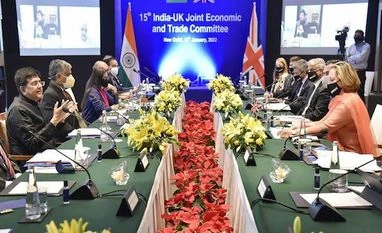
Reuters New Delhi/ London Britain and India formally launched free trade agreement talks in New Delhi on Thursday with the aim of wrapping up a deal by the end of the year that could boost annual bilateral trade by billions of pounds.
Britain has made a deal with India one of its post-Brexit priorities as, free from the European Union's common trade policy, ministers look to gear trade policy towards faster-growing economies around the Indo-Pacific region.
Meeting in New Delhi on Thursday, Indian trade minister Piyush Goyal and his British counterpart Anne-Marie Trevelyan said they would also launch an "early harvest" or a limited-scope interim trade agreement in the next few months, before finalising the free trade agreement.
"This is an opportunity that we must seize to steer our partnership along the track of mutual prosperity for the decades to come," Trevelyan said.
Britain said the deal could almost double British exports to India, and by 2035 boost total trade by 28 billion pounds ($38.3 billion) per year. Total trade in 2019 was worth 23 billion pounds, according to British statistics.
India and former colonial power Britain already share strong trade ties, and more than a million people of Indian origin live in Britain after decades of migration.
India is seeking greater opportunities for Indians to live and work in Britain, and any trade deal could be contingent on relaxing rules and lowering fees for Indian students and professionals going to Britain.
However, Goyal said that sensitive issues will not be a roadblock as both countries will not make them a necessary condition for the trade deal.
"Nothing is necessarily a deal-breaker in this agreement," Goyal said.
"And I will not think there is any way for anybody to worry about issues which are sensitive to any country, because both sides have agreed that sensitive issues are not our priority," he added.
Ministers want to tap into the wealth of India's middle classes and their appetite for premium British products like Scotch Whisky. They also hope India can become a big customer of its green technology industry, and that existing service sector trade routes can be strengthened.
(Only the headline and picture of this report may have been reworked by the Business Standard staff; the rest of the content is auto-generated from a syndicated feed.)

 "Britain, India aim to finalise free trade agreement by year-end")


 Connect with us on WhatsApp