Home / India News / China has commercial, military interests in Gwadar: US think-tank
China has commercial, military interests in Gwadar: US think-tank
The think-tank commended the Trump administration for its efforts to strengthen partnership with India
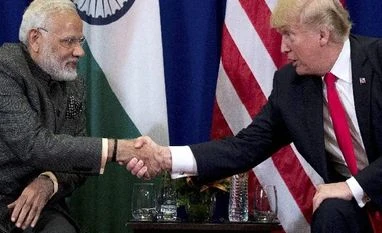
Manila: President Donald Trump, right, and Indian Prime Minister Narendra Modi shake hands during a bilateral meeting at the ASEAN Summit at the Sofitel Philippine Plaza, Monday, Nov. 13, 2017, in Manila, Philippines | Photo: AP/PTI
China has both commercial and military interests in the Pakistani port of Gwadar, the US think-tank community has told lawmakers while lauding the Trump administration for strengthening its partnership with India across all the services -- political, civilian and military.
At the same time, recent developments indicate the Pakistani leadership has increasingly been realising that Chinese investment is more about the latter's economic and strategic interest, members of the community told lawmakers during a Congressional hearing on Pakistan by the House Foreign Relations committee.
"Going back a decade, a lot of Indian strategists were concerned about and publicly complaining about the possibility China would build a string of pearls of port facilities and logistics facilities along the Indian Ocean rim and those concerns were sort of downplayed at the time," said Jeff Smith, research fellow for South Asia at the Heritage Foundation.
"But I think they may have just come a decade too early, because what we have seen in recent years is that China does have plans for military facilities and installations," he said in response to a question from Congresswoman Ann Wagner.
Smith commended the Trump administration for its efforts to strengthen partnership with India.
"That, in some ways, we see India as a net provider of security in the Indian Ocean and that partnership has made really dramatic progress over the past 10 years," he said.
Smith said The US has a unique relationship with Prime Minister Narendra Modi and the Trump administration is "very bullish" to move it forward.
"A strong US-India partnership more than anything will secure our interests in the Indian Ocean," he said.
Noting that last fall Pakistan refused to capitulate to China's demand to accept Chinese currency within the Gwadar free zone, Ann Wagner asked if they see Beijing's funding conditions for the China-Pakistan economic corridor becoming a wedge issue that inhibits cooperation between the two countries.
"President Trump has advocated for 350-ship Navy, given that China seems to have designated Gwadar a future PLA naval base, are we doing enough to prepare for China's creep westward?" she asked.
"There have been reports of rising tensions. Pakistan also refused Chinese assistance for Bhasha dam because the conditions were too stringent. Pakistan's minister for shipping told the senate that 90 per cent of the revenue from Gwadar will go to China," said Aquil Shah, a non-resident scholar in the South Asia Program at the Carnegie Endowment for International Peace, and Wick Cary, assistant professor in the Department of International and Area Studies at the University of Oklahoma.
Shah said Pakistani officials realise that this is not about Pakistan's economic development per se but about Chinese commercial economic interests.
"And so, there is tensions also amongst the smaller provinces because they feel like, again, this project has been hijacked by the Punjab and left them out of the loop. So, there's domestic tension but there's also frictions with China on certain issues, including the currency issue," he said.

 "China has commercial, military interests in Gwadar: US think-tank")


 Connect with us on WhatsApp