
Climate experts say El Nino responsible for heavy Chennai rains
Also blame poor town planning as the canals are blocked and there is no way the excess rain could be drained
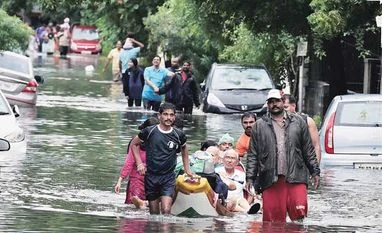 "Climate experts say El Nino responsible for heavy Chennai rains")
WebinarsNew
Deep DiveNew
Explore Business Standard
Also blame poor town planning as the canals are blocked and there is no way the excess rain could be drained
The NE monsoon, which supplies 60% of Tamil Nadu's annual water requirement started with a deficit in October but the impact of the El Nino, the weather phenomenon that triggers atmospheric changes has resulted in historic rainfall. The NE monsoon hits Tamil Nadu, Rayalaseema, coastal Andhra Pradesh, South interior Karnataka and Kerala.
Meteorologists predict incessant rainfall in and around Chennai till December 6.
"There have already been 3 to 4 heavy rain events in the last 15 -20 days over Tamil Nadu. We will get more rain in the next four to five days," said B P Yadav, deputy director general, Indian Meteorological Department (IMD).
The El Nino phenomena, the severest this year, could have potential impact on weather events across the globe. Incidentally, Cyclonic events have not happened in 2015 on the Bay of Bengal coast during the North east monsoon, the first such recorded in more than a decade.
"As of now, El Nino continues to be strong. In an El Nino year, the South west monsoon will have deficit rains and North East monsoon will see excess rainfall," said G P Sharma, vice president, meteorology at Skymet, the private met agency.
J Srinivasan, Chairman, Divecha Centre for Climate Change at the Indian Institute of Science attributed the formation of low pressure clouds in the Bay of Bengal that has caused heavy rains as there has been no cyclone.
"It is a surprise for all of us. We need to look at the data once this phenomenon ends," said Srinivasan.
Dr A Jayaraman, director of the National Atmospheric Research Laboratory (NARL), the weather research arm of Indian Space Research Organisation says cyclonic winds weaken after it hits the coast but the destruction could be enormous. Low pressure winds that carry rain experienced in the Chennai coast move slow.
"Cyclone is like an express train. It hits the coast and leaves a trail of destruction. But this fellow (low pressure winds) doesn't move fast like a cyclone. It is like a passenger train, it remains there for three to four days and pours," said Jayaraman, while blaming the current crisis in Chennai as manmade.
"There is no problem with the rain. Problem is with poor town planning. The canals are blocked and there is no way the excess rain could be drained," he said.
First Published: Dec 02 2015 | 8:00 PM IST


 Connect with us on WhatsApp