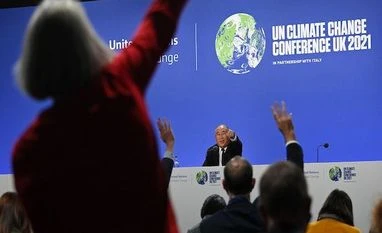
Event organizers are planning a return to in-person confabs as soon as the pandemic dissipates despite the environmental benefits of keeping things online.
From airmiles and gas-guzzling shuttle buses to lake-sized quantities of plastic bottled water and piles of brochures, events can exact a heavy toll.
Pre-COVID, the annual carbon footprint for the global event and convention industry was on par with the yearly greenhouse gas emissions of the United States, according to a study by Cornell University and researchers from the American Center for Life Cycle Assessment published in Nature last month.
They estimate moving a conference completely online would cut its carbon footprint by 94%, while shifting it to a hybrid model, with up to half the participants online, would cut it by two-thirds.
Conference organizers, however, say the full benefits of professional get-togethers can only be realized when people actually get together: the networking that happens before and after presentations, the real-life sizing up of rivals and products, the in-person interactions that can make or break negotiations.
"Creating happenstance is really challenging in the virtual world," said Phillip Maggs, innovation director at events agency Identity, the organizer of last year's COP26 United Nations climate summit in Glasgow.
Organizers can also charge more for in-person meetings. In general, digital events generate approximately 50% less revenue than in-person conferences due to lower ticket prices and less sponsorship, said Beth Surmont, vice president of event strategy and design at 360 Live Media.
Six major conference organizers, including the people behind the CES consumer technology tradeshow and real estate conference MIPIM, told Reuters they plan to return to in-person events on the same scale as before the pandemic and mitigate their carbon footprint as best they can.
CLIMATE CONFERENCE
The events industry is expected to bounce back from the coronavirus with the overall market, including music events, exhibitions and festivals as well as corporate conferences, expected to grow to $2.2 trillion in 2028 from $887 billion in 2020 according to Verified Market Research.
After nearly two years of COVID restrictions, people are keen to reconnect. Omicron foiled CES' big comeback this month but even with cases of the highly transmissible variant surging globally, more than 40,000 people attended the tech conference in person in Las Vegas.
In 2019, the year before the pandemic struck, over 175,000 people went.
The COP26 Coalition, a grouping of UK-based civil society groups, said hosting the U.N. global climate talks physically last year was the only way to provide adequate representation for developing nations.
"Of course we want to ensure that these conferences have the lowest carbon footprint possible, but in terms of the global economy and issues, I think the alternative is even worse," said COP26 Coalition representative Asad Rehman.
Around 40,000 delegates from scores of countries attended the talks in Glasgow and the two-week event deployed a range of measures from donating the 15,000 square meters of carpets it used to providing participants with reusable aluminum water bottles and a largely locally-sourced menu to ensure they were carbon neutral.
Scores of private jets were chartered to ferry some VIP delegates to and from COP, however, garnering criticism.
Marco Rodzynek, CEO of the annual NOAH technology conference in Zurich, said they encouraged participants to use trains or other forms of public transportation.
NO MEAT MENUS
Conference organizers such as Informa Plc and the host of the K5 Future Retail conference in Berlin offer attendees the opportunity to purchase carbon offsets when they book their spot.
Carbon offsets enable a polluter to buy into an emissions reduction project such as a tree-planting initiative and use the credit awarded to offset the impact of their own emissions.
Many climate scientists and environmental groups argue that they cannot compensate for carbon emissions because they are not always effective or sufficiently supervised and they don't tackle the root of the problem -- activities that produce greenhouse gases.
Not all conference organizers endorse carbon offsets.
Rodzynek said that it was more effective to add virtual attendance options to events and implement other sustainability measures, such as abolishing meat and fish from menus and offering plant-based food.
"Out of 1,400 attendees, not one asked us about offsets," he said. "People are using it just for marketing."
One subscription. Two world-class reads.
Already subscribed? Log in
Subscribe to read the full story →
Smart Quarterly
₹900
3 Months
₹300/Month
Smart Essential
₹2,700
1 Year
₹225/Month
Super Saver
₹3,900
2 Years
₹162/Month
Renews automatically, cancel anytime
Here’s what’s included in our digital subscription plans
Exclusive premium stories online
Over 30 premium stories daily, handpicked by our editors


Complimentary Access to The New York Times
News, Games, Cooking, Audio, Wirecutter & The Athletic
Business Standard Epaper
Digital replica of our daily newspaper — with options to read, save, and share


Curated Newsletters
Insights on markets, finance, politics, tech, and more delivered to your inbox
Market Analysis & Investment Insights
In-depth market analysis & insights with access to The Smart Investor


Archives
Repository of articles and publications dating back to 1997
Ad-free Reading
Uninterrupted reading experience with no advertisements


Seamless Access Across All Devices
Access Business Standard across devices — mobile, tablet, or PC, via web or app
)