COP26 and energy transition: An outlook on India's stance

The COP26 Energy Transition Council (ETC) reiterated the fact that an immediate and just transition to clean energy holds great significance in order to meet the Paris Agreement goals
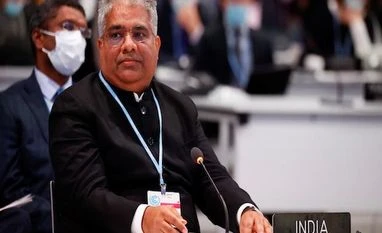
India's Environment Minister Bhupender Yadav attends the UN Climate Change Conference (COP26) in Glasgow (Photo: Reuters)
Somesh Kumar
5 min read Last Updated : Nov 16 2021 | 3:11 PM IST
With more than 200 parties exemplifying their plans to slash their GHG emissions thereby trying to cap the global temperature rise within 1.5°C, COP26 can be considered as one of the most anticipated and the biggest international summits so far in the history of climate action. One of the key focus areas of the conference remains to devise a global Net Zero plan and keep the rising temperature in check.  The first week of the Convention, in Glasgow, witnessed leaders from across the globe setting forth meticulous goals and commitments to fulfil the latter objectives. 

The COP26 Energy Transition Council (ETC) reiterated the fact that an immediate and just transition to clean energy holds great significance in order to meet the Paris Agreement goals. Globally, an approximate 6,900 TWh of electricity was generated from renewable sources in 2019 – an increase of 5.5% when compared to renewable electricity generation in 2018. While such initiatives on transition to clean energy is underway - ETC asserts that the pace needs to at least quadruple over the next ten years to avoid the harmful effects of climate change.

The world leaders have dedicatedly rolled out plans in lieu of the key objectives of the Convention. Some of the notable points made are as follows:

UK Prime Minister, Boris Johnson, has established an international program to bring clean and affordable technology everywhere by the year 2030 and therefore achieve the goal of Net Zero. This Agenda has been signed by most countries including the US, India, EU, China, developing countries and some of the nations considered to be the most vulnerable to climate change

Furthermore, he launched the Clean Green Initiative – a £3 billion large investment that will support the introduction of sustainable infrastructure and cutting-edge green technologies in developing countries to combat climate change while also stimulating the economic growth of these nations3

The Regulatory Energy Transition Accelerator (RETA) was launched by International Energy Agency (IEA), Ofgem, International Renewable Energy Agency (IRENA) and World Bank. The accelerator will help speed up the pace of clean energy transition. It will especially assist economies with less developed energy systems to plan their transition in a just and clean manner

23 countries, including the world’s top 20 coal-fired power generating countries have made pledges to phase out coal power

More than 100 nations have joined the Global Methane Pledge. A US-EU led initiative, the pledge will focus on national-level voluntary actions to contribute to reduce the global methane emissions by at least 30% by 2030, using a 2020 baseline

Phasing out of coal took centre stage next when 28 countries joined “Powering Past Coal Alliance” and made significant commitments. The International Energy Agency (IEA) revealed that pledges made at COP26 so far could see global warming limited to 1.8 degree C above pre-industrial levels by 2100

In recent years, India has become a pioneer in climate protection and is one of the few countries to have performed exceptionally on the mitigation goals of NDCs. Hon’ble Prime Minister, Shri Narendra Modi, in his speech at COP26 highlighted how India expects developed nations to provide climate finance of $1 trillion while also stating the nation’s five point resolution. India will

1. Bring its non-fossil based energy capacity to 500 GW by 2030

2. By 2030, fulfil 50% of its energy requirement through renewable energy

3. Cut down its net projected carbon emission by 1 billion tonnes till 2030

4. Reduce carbon intensity of its economy by more than 45% by 2030, and

5. By 2070, India will be ‘net-zero’.

India currently ranks 4th worldwide in installed renewable energy capacity. Additionally, India has successfully produced energy from non-fossil fuel sources by more than 25% in the last 7 years thereby reaching 40% of the country’s energy mix.

India has demonstrated active leadership in welcoming aboard US and other countries in the International Solar Alliance, initiating discussions across the globe through One Sun One World One Grid which aims to ensure that clean and efficient energy is the most cost-effective, accessible, and reliable option for all nations to meet their energy needs by the year 2030. The steep and ambitious commitments announced by India at COP26 would need technology readiness, upgraded capacity to implement, and above all climate finance. India’s railway sector would need to undertake heavy decarbonisation measures owing to its high reliance on diesel and coal fired electricity.

India has expressed keen interest on scaling up of green hydrogen and mandating its use in industries like petroleum refineries and fertiliser. This deep decarbonisation push will lead to several investments across renewable energy, energy efficiency and new energies like green hydrogen and alternatives like biofuels.

In reference to the highly discussed water-down on coal commitments at the COP, India has taken a stance on phasing down of coal (instead of phaseout), which has never been attempted in the past. This is testimony to the realistic approach of phasing-down before phasing-out, hinting at an eventual end of coal based energy generation in the country.

India, the world’s fourth biggest carbon dioxide emitter for the first time has expressed a concrete target year for achieving Net Zero status. If successful, India will pave the way as a leader setting forth examples for the developing nations in the field of climate mitigation. However, to fulfil this goal, it is of great significance that a focused and phased approach be followed, supported by climate finance as promised by many of the developed countries at this COP. A dedicated plan and robust implementation of strategies is what will help achieve India reach Net Zero by 2070.

The author is Partner & National Leader – Power & Utilities, EY India. Tania Banerjee, senior professional in Consulting at EY India also contributed to the article. Views expressed are personal

One subscription. Two world-class reads.

Already subscribed? Log in

Subscribe to read the full story →
*Subscribe to Business Standard digital and get complimentary access to The New York Times

Smart Quarterly

₹900

3 Months

₹300/Month

SAVE 25%

Smart Essential

₹2,700

1 Year

₹225/Month

SAVE 46%
*Complimentary New York Times access for the 2nd year will be given after 12 months

Super Saver

₹3,900

2 Years

₹162/Month

Subscribe

Renews automatically, cancel anytime

Here’s what’s included in our digital subscription plans

Exclusive premium stories online

  • Over 30 premium stories daily, handpicked by our editors

Complimentary Access to The New York Times

  • News, Games, Cooking, Audio, Wirecutter & The Athletic

Business Standard Epaper

  • Digital replica of our daily newspaper — with options to read, save, and share

Curated Newsletters

  • Insights on markets, finance, politics, tech, and more delivered to your inbox

Market Analysis & Investment Insights

  • In-depth market analysis & insights with access to The Smart Investor

Archives

  • Repository of articles and publications dating back to 1997

Ad-free Reading

  • Uninterrupted reading experience with no advertisements

Seamless Access Across All Devices

  • Access Business Standard across devices — mobile, tablet, or PC, via web or app

Topics :Climate ChangeEnergy

Next Story



