The Delhi government and Centre are once again at loggerheads over the reason behind alarming levels of pollution in the national capital. While Delhi Chief Minister Arvind Kejriwal has held crop fires in Punjab and Haryana responsible for the pollution, Union Minister Anil Madhav Dave said Delhiites are responsible for it.
Madhav's claim also contradicted the claims of a safar's (System of Air Quality and Weather Forecasting and Research) scientist.
Gufran Beig, program director of Safar, under the Earth Sciences Ministry, has said that the proportion of pollutants from crop fires in Delhi's air rose dramatically from almost zero on November 1 to a peak of 70% on November 6, basing his assessment on computer models used to determine the capital's air quality index, a report by the Times of India said.
"Safar's chemistry transport model gives a clear picture of the share of pollution from external sources. It shows pollution load from crop fires in Punjab and Haryana rose steadily after November 1 due to favourable upper air winds," Beig said.
Meanwhile, the Delhi government has demanded that the Centre conduct a fresh study to find out sources of emission and their respective share in polluting the national capital's air.
Delhi Environment Minister Imran Hussain wrote to his Union counterpart Dave urging him to instruct the Central Pollution Control Board (CPCB) to undertake the scientific investigation.
His letter came on a day neighbouring Haryana and Punjab rejected the city government's argument that biomass burning in their states was largely responsible for the capital's foul air and alarming levels of smog.
"...satellite imagery from NASA shows large scale crop burning and pollution from the industries of nearby states like Punjab and Haryana, which have tremendous amounts of pollution.
"In this scenario, it is imperative that the source of emissions and their respective pollutant load contribution is investigated for the entire NCR," Hussain wrote.
This, he said, will ensure that states "own up" to their responsibilities.
Early this year, a team led by IIT-Kanpur Professor Mukesh Sharma had submitted a report titled 'Comprehensive Study on Air Pollution and Green House Gases (GHGs) in Delhi'.
The widely quoted report had put the contribution of biomass burning in pollution within the city (during winters) at 17 per cent (for PM 10) and 26 per cent (for PM 2.5).
PM 2.5 and PM 10 are ultrafine respirable pollutants that are harmful to the respiratory system and can lead to cardiac issues in human beings.
Delhi itself responsible for its worsening air: Dave
The Union Environment Minister has said that Delhi is itself responsible for the 80 per cent of the worsening air in the city and that there is a need for ending the blame game over the issue.
At a meeting of the environment ministers of Delhi-NCR states to find a solution to combat the problem, he said crop stubble burning contributed just 20 per cent of the pollutants. Neighbouring states of Haryana and Punjab also put the blame on Delhi.
"Stubble burning is 20 per cent of the problem. Delhi's responsibility is 80 per cent. Burning of petrol/diesel, coal, wood, dry leaves and of garbage at a waste disposal ground led to pollution in Delhi. Burning of crackers can be added to that as well," Dave said.
Even as the Delhi government announced a slew of measures last week to combat the deteriorating air quality in the national capital, the official data showed that action was not taken when it was really needed — in August, when pollution levels started to spike, according to the Indian Express.
Various departments of the Delhi government, municipal corporations and the Delhi Development Authority (DDA) issued more challans against polluters — for open burning, construction, demolition, etc — from January to August than over the last three months.

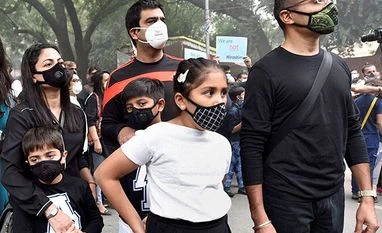 "Crop fire or Delhiites responsible for pollution? Kejriwal, Centre begin blame game")


 Connect with us on WhatsApp