
Delhi's air quality 'poor' but improves marginally as wind speed picks up
The national capital's air quality improved marginally due to favourable meteorological conditions, but was still in the "poor" category
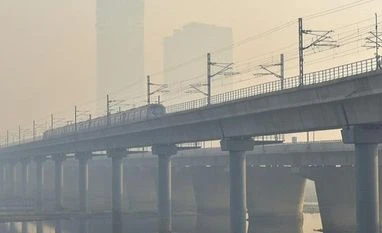 "Delhi's air quality 'poor' but improves marginally as wind speed picks up")
WebinarsNew
Deep DiveNew
Explore Business Standard
The national capital's air quality improved marginally due to favourable meteorological conditions, but was still in the "poor" category
The national capital's air quality improved marginally on Wednesday due to favourable meteorological conditions, but was still in the "poor" category.
The central government's Air Quality Early Warning System for Delhi said "fire counts" reduced in Punjab (around 2,400) on Tuesday, but were "still significantly high and are likely to impact the air quality in Delhi-NCR and northwest India".
The share of stubble burning in Delhi's pollution had dropped to 10 per cent on Tuesday due to a change in the wind direction. The city recorded an air quality index (AQI) of 279 at 10 am as wind speed picked up.
The 24-hour average AQI was 302 on Tuesday. It was 293 on Monday and 364 on Sunday.
An AQI between 0 and 50 is considered "good", 51 and 100 "satisfactory", 101 and 200 "moderate",201 and 300 "poor", 301 and 400 "very poor", and 401 and 500 "severe".
According to the Ministry of Earth Sciences' air quality monitor, SAFAR, said the share of stubble burning accounted for 16 per cent of Delhi's pollution on Monday and 40 per cent on Sunday, the maximum so far this season.
It was 32 per cent on Saturday, 19 per cent on Friday and 36 per cent on Thursday.
Last year, the farm fire contribution to Delhi's pollution had peaked to 44 per cent on November 1, according to SAFAR data.
According to the India Meteorological Department, the maximum wind speed was 15 kilometers per hour on Wednesday.
The city recorded a minimum temperature of 10.6 degrees Celsius. Calm winds and low temperatures trap pollutants close to the ground, while favourable wind speed helps in their dispersion.
According to the Air Quality Early Warning System for Delhi, the city's ventilation index a product of mixing depth and average wind speed was expected to be around 9,5000 metre square per second on Wednesday favourable for dispersion of pollutants.
Mixing depth is the vertical height in which pollutants are suspended in the air. It reduces on cold days with calm wind speed.
A ventilation index lower than 6,000 sqm/second, with the average wind speed less than 10 kmph, is unfavourable for dispersal of pollutants.
(Only the headline and picture of this report may have been reworked by the Business Standard staff; the rest of the content is auto-generated from a syndicated feed.)
First Published: Nov 04 2020 | 10:57 AM IST

