Discovery Networks is entering a phase of discovery in India. For years, it has dominated the infotainment genre on television. But with just 2 per cent share of the total TV viewership and a mere 3 per cent of the TV advertising pie, this genre offered restricted scope for growth. Now, Discovery wants to play in the bigger game. And that is why it is taking the audacious gamble — come February next year — of launching a Hindi general entertainment channel (GEC) called Jeet.
This will bring it head-on with the big established giants — Star, Sony, Zee and Colors — which have carved out this market amongst themselves with their numerous channels.
Latecomers to the game, the US-based broadcasting company is putting in some big bucks — sources says as much as Rs 600 crore, which is more than its 2016 turnover of about Rs 400 crore, just to kick start the channel. It is also producing a thousand hours of original content to power its channel. And apart from Hindi, it will be available in Telugu and Tamil feeds.
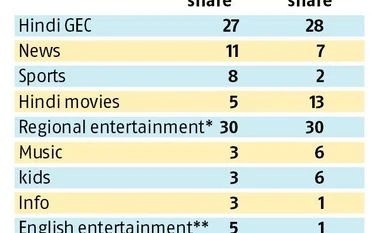
Explaining this tectonic shift in the broadcaster’s thinking on India, 39-year-old Karan Bajaj, senior vice-president and general manager (South Asia) for the broadcasting company in India (and a best-seller writer), says: “There are 250 million TV households. Currently, we are focused on the top of this pyramid of 15 million households which are English speaking and see English programming. We now want to reach the masses, which is the next 100 million households in this pyramid, and that can only be through GEC. The remaining households are on free-to-air”. It’s, of course, no rocket science to realise why GEC is key for any broadcaster that has ambitions of becoming a big player in the domestic TV broadcasting business. After all, Hindi GEC constitutes 28 per cent of the viewership and accounts for 27 per cent of the TV advertising revenues. Larger than that is the combined regional GEC share, in which Discovery is putting a small foot by having the two regional feeds.
Hindi GEC might have the viewers, but to make money you need to make consistent and large investments and break the clutter in content. The last successful launch of a new channel in this space was 10 years ago with Viacom’s Colors. After that no one really tread into this hyper competitive space. Says a senior executive of a GEC channel: “There is a huge clutter in this space with 7-8 channels plus OTT platforms, and you need to sink in at least Rs 3,000 crore for three years before you can think of making money. So, a broadcaster must be hugely committed and patient. It is not for the faint- hearted”.
Discovery might not be faint-hearted, but it has no experience in running a GEC channel anywhere globally. Also, its content strategy has to be completely revamped. Discovery, which till now produced just seven hours of original content in a year in India and imported most of its programming from the mother company at an incremental cost, now has to handle and invest in 1000 hours of local programming — a jump of over 140 times. Also, it has to substantially overhaul its distribution, which is currently geared at the premium end of TV households, to cater to the mass viewers.
Its new channels, especially to cater to the larger audiences, has not put the house on fire. Discovery ID, the crime channel in Hindi (the stories are foreign), for instance, is being replaced by Jeet because it did not garner enough viewers. Analysts say its foray in sports through DSports has been lukewarm (the company says it’s a niche channel). But Discovery points out that with about 24.8 per cent share of the infotainment space, it has the top slot based on BARC data for males above 15 years, in premium A and B segments in all India urban. Of course, the pecking order changes if consumers over 2 years in the 6 mega cities are taken into account. History 18 is the number one channel in that segment, but that is not the market they are aiming at.
Karan Bajaj, Discovery Channel
Bajaj has a clear plan to ensure the GEC gamble pays off. He believes customers are channel agnostic and choose what they see based on what content attracts them. So, he is trying to differentiate content from competition — the anchor programmes will be inspired by real life and dramatised for TV. One example is its 85-episode dramatised rendering of the life of Baba Ramdev. “What we will provide is purposeful content just like Discovery does, but instead of a niche audience, it will be for the masses,” says Bajaj. In order to create loyalty for the programme, Bajaj is signing up serials that will have over 80 episodes, on average. Discovery has already commissioned about 3 hours of original content every day — which will be reinforced by another 2 hours of programming via acquisition. Bajaj says that this is the norm for any GEC channel and they are following the same. That, of course, does not come cheap. Experts say that the broadcaster would have to fork out over Rs 200 crore just for original content.
He is also aware that distribution needs to be beefed up. Since Jeet will replace the slot currently held by Discover ID, which did not take off, Bajaj says that being a Hindi channel, the network already has access to 60-70 million households. Efforts are on to double the distribution reach before the launch of Jeet.
Discovery is also looking at synergies with the digital mobile space. So, while it will not set its own over-the-top (OTT) platform, Bajaj says Discovery is talking to other OTT players who are looking at tying up with them for their content not only for Jeet, but also for the other channels.
Bajaj and his new revamped team (which recently shifted its headquarters from Delhi to Mumbai) have their work cut out. And he points out that they have an ambitious target to meet — to triple their turnover in the next three years. The key to that, of course, is to win the Jeet battle.