Female Hindu priests breaking into male bastion, but equality still a dream

A quiet revolution may be just about to get a bit noisy
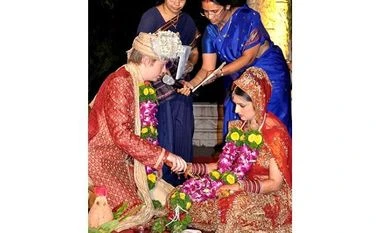
Jnana Prabodhini's Manisha Shete (second from left) conducts a wedding ceremony
Jnana Prabodhini’s Manisha Shete (second from left) conducts a wedding ceremony
Manavi KapurRanjita Ganesan
Last Updated : Oct 12 2018 | 10:47 PM IST
In a 2005 paper titled “Gender and Priesthood in the Hindu Traditions”, Vasudha Narayanan, Distinguished Professor at the University of Florida’s department of religion, wrote in the f, “When I first came as a student to the Harvard Divinity School in 1975 several students asked me if women could become priests in Hinduism.” Over four decades later, the question posed to Narayanan continues to be pertinent — and unresolved. Even as women gain the right of entry into male-only temples and religious spaces, the idea of a Hindu woman priest is still absurd to some, fascinating to others and wholly unheard of to a majority of Hindus in India.

The role of a priest in Hinduism is multi-faceted and distinct in character from other religions. A Christian priest, for instance, plays a greater social role while presiding over his parish. An Islamic cleric leads Friday prayers and directs social conduct and customs. In Hinduism, a priest is the keeper of scriptures, a via media for abstruse Sanskrit shlokas and rituals. 

A Hindu priest also conducts domestic ceremonies and pujas, and presides over the daily workings of a public temple.

Virtually invisibly, women have been creating a niche space for themselves in the private religious space. In pockets of Maharashtra, for instance, institutes have been leading a small revolution by training women to be Hindu priests and in turn democratising pujas and other Hindu ceremonies to resonate with a younger, contemporary audience.

For his wedding in July this year, Girish Joshi, a textile consultant based in Baroda, enlisted the services of women purohits. He had seen them conduct rituals in the style of the Pune-based organisation Jnana Prabodhini at a family wedding in Pune four years earlier. Not only were the verses explained, but guests were encouraged to participate in the proceedings too, unlike at typical weddings where “nobody is usually interested in the actual ceremony”. It appeared to combine traditional ways with modern lifestyles, says Joshi. “We found that the women purohits were knowledgeable and equivalent to their male counterparts, if not better than them.”

At Swapnila Sethia’s home in Pune, women priests have led every religious event, from weddings to vaastu shanti (housewarming) and last rites, for at least 15 years. It did not sit well with her that some pujas traditionally gave less importance to women, and that the orthodox priests performing them charged a lot of money. The 38-year-old psychologist’s family has always been open-minded, and it was her grandmother who first supported the idea. However, not all senior relatives are quite so permissive. Attending pujas at Sethia’s home had inspired her sisters and friends to invite women priests too, but this sometimes caused problems. The elders of the household concerned might, for instance, believe that rites performed by women will not reach God, leading them to repeat the rituals with the services of male priests. In her observation, women priests tend to be precise, abiding by only the most important aspects of the rituals. “And they make you feel comfortable.”

Among these women priests was Manisha Shete, who first began to officiate at religious ceremonies in 2008. She is now invited to lead around 60 ceremonies a year. A doctor of philosophy, she works with Jnana Prabodhini, a Hindu reformist organisation that trains men and women across castes to perform rituals. The organisation has taught 25 women in Pune, and 13 in Mumbai so far, through its one-year programme. Upon completing this course, the “trainees” shadow senior women purohits for three months until they are confident and comfortable interacting with families. Several go on to train others or begin taking up requests to conduct rituals. The women ask for only a fraction of what male bhatjis (Marathi for priests) charge. Two women priests usually conduct a marriage ceremony and accept Rs 1,000 each; male priests charge anywhere upwards of Rs 5,000.

Jnana Prabodhini’s Manisha Shete (second from left) conducts a wedding ceremony
Three years ago, when Shete presided over the wedding of a Maharashtrian woman and a German man in Germany, she had the verses translated and transliterated so that the bridegroom could read along too. Now, Shete says she gets three to four requests per year from families overseas to conduct rituals over Skype. It is typically young and middle-aged couples who call upon women priests. In 2015, Shete featured in an episode of a Marathi daily soap, Asa He Kanyadaan, as the purohit officiating at the marriage of the lead characters.

Votaries of Jnana Prabodhini hold that menstruation is a natural and positive phenomenon and should not be considered an impediment to women’s participation in religious events. The organisation is now working on designing an online course in a number of languages which will be taught through Skype. The feedback most women priests get, says Shete, is that women are sincere and emotionally involved. “Families like to talk to them and sometimes even ask for advice on certain matters. At such times, we listen and offer some counselling.”

Separately, groups of female priests have sprung up in Thane and Navi Mumbai too, chanting stotras (sacred verses), including the rudram, often forbidden to women. The Vitthal-Rukmini temple in Pandharpur is known to have appointed women priests. Locals in Raigad’s Mohapada village, too, regardless of their gender or caste, have been learning Sanskrit and religious verses at Indira Sanksrit Pathshala. The mission was launched around 2000 by Rameshwar Karve, a venerable Sanskrit scholar now aged 102, who has trained many tribal women and at least three Muslim women since. Known locally as Tattya, Karve believes the exclusion of women is a relatively late phenomenon and that Hinduism does not prescribe it. His granddaughter, Ashwini Gadgil, says he spent his own money and went around teaching for free in schools and homes. She too hopes to make courses available online and has sought the assistance of Tattya’s younger students for this.

Lalita Dalvi had been a typist and accountant until 1998 when the company she worked with closed down. “In those years, I did not even know the Gayatri mantra,” she says. She had offered Tattya space in her home to teach, and soon picked up the stotras herself. She is one of the first women priests to emerge from the effort, which has produced as many as 200 expert women chanters. Dalvi and members of her group conduct about two ceremonies a month, often dressed in white saris with red or golden borders, sometimes travelling to Mumbai and Pune. It is not just educated families who invite them, says Dalvi, but also others who simply want to follow what they see the sarpanch or other influential people talking about. Even now, awareness is relatively low. “People still say they don’t need women to head the pujas. But who does everything from buying flowers, cleaning, cooking prasad, and preparing the venue for a puja? Women.”

When the female priests occasionally hear comments challenging the auspiciousness of their work, they try to put forth their views patiently. “Or we listen and ignore it,” says Shete.

Nandini Bhowmik (second from left) solemnised her daughter’s wedding in Kolkata
Kolkata’s Nandini Bhowmik is one of the few examples of a female priest outside of these Maharastrian organisations. A Sanskrit professor and theatre artiste, the 58-year-old conducts ceremonies at weddings, annaprashans (to mark the first grain an infant eats), griha pravesh (housewarming) and shraadh (praying for the souls of one’s ancestors). “I was in college where my teacher, Gouri Dharmapal, taught my friend and I the basics of how to conduct such ceremonies,” she says. Dharmapal had developed a script for rituals that combined an explanation of complex shlokas and rabindrasangeet to make the hymns more appealing. “Certain Hindu rituals can be so elaborate and boring. We try to shorten these, especially by deleting some rituals that are insulting to women,” she says.

Among the practices Bhowmik has done away with is the shaath paake ghora, a ritual where a bride is brought to the wedding mandap seated on a tiny pedestal and lifted up by her brothers. She then goes around her groom seven times before seeing him. “This is a vestige of the times when a Bengali bride used to be a child who was married off and given no chance to study. Such practices have no place in today’s world,” she says. Another ritual she does not perform during weddings is one where a bride has to throw rice puffs at her father, as if repaying her debt to him. “I solemnised the weddings of my daughters and was lucky that their in-laws were in agreement with this,” says Bhowmik.

The concept of female priests is not entirely unknown, though. The tenets of the Arya Samaj, a reformist faction of Sanatan Dharma Hinduism, allow for women to be priests and conduct rituals. Arya Samaj ashrams and gurukuls for young girls teach them the scriptures. And even the staunchest Hindu believers have their women perform pujas in their homes, the female of the house being the keeper of tradition and custom. Jaggi Vasudev, a self-styled spiritual guru, in fact, uses this argument to justify why Hindu women are not allowed to be priests. “In this country, only the public temples were maintained by men because they were more suitable to manage the public. But there was no home without a little shrine, and these private shrines were always maintained by women. So in that sense, more temples were managed and maintained by women than by men, and it is still so,” reads an article on the website of the Isha Foundation, an organisation led by Vasudev.

Views such as these continue to keep women from taking their place inside sanctum sanctorums or leading public ceremonies. In a recent case at the Delhi High Court, some women from the 700-member-strong Brahmin families who are considered the custodians of New Delhi’s Kalkaji Mandir filed lawsuits to claim their right to perform puja seva in the temple. Traditionally, Brahmin families get turns to preside over the daily rituals at temples. These monthly baaris (turns) are conducted by the male members of the families, since, once the women born into the families get married, they take on their husband’s gotras (clan names). The court battle, though, was not merely about the right to perform rituals. There are considerable financial benefits to being a temple priest.

Deepak Bharadwaj, a former member of the Kalkaji Mandir Trust, declares that women should be given their fair share. “Most cases were settled even though many elders felt that this is because the women became greedy and were more interested in the money than the actual puja,” he says.

From all accounts, the puja seva is not onerous, but Bharadwaj is cryptic about what exactly the responsibilities are. “These are age-old rituals that I cannot disclose. But women cannot do these rituals and that change is not possible,” he says. “Maybe ashuddh (impure) is an incorrect word here, but women having their period cannot be expected to perform mata ki sewa,” he equivocates. The argument is that if women were to perform these rituals, they would be interrupted at least once a month because of the menstruation cycle. Bharadwaj is oblivious to the irony that it is the service of a goddess (Kalka Mata) that the women are fighting for.

Biological hurdles aside, social customs and codes dictate that women be home-bound. In her paper, Narayanan explains this aspect in detail. “The relationship between the patron of a ritual (yajamana) and the priest (purohita) is considered to be one of familiarity. Thus, in many rituals, the priest ties a protective amulet around the patron’s wrist and the patron wears it until he completes the ritual. If a woman is also doing the ritual, the husband ties the thread on her wrist. Since the tying of the amulet is an act of binding two people ritually, it is argued that a woman priest cannot tie it on the hand of anyone but her husband, and certainly not on the wrist of any strange man.” The economic aspect is also problematic for conservative Hindus. As Narayanan writes, “A woman cannot receive payment for services from a man.” 

Temple organisations also represent political clout and membership comes with benefits. Women in Haridwar, for instance, have rallied to claim voting rights to the Ganga Sabha, an organisation that maintains the ghats in Haridwar as well as conducts aarti at Har-Ki-Pauri. Founded by Madan Mohan Malaviya in 1916, the Sabha has 782 members and has never had a female representative since its inception. While a final decision on the matter is pending, it points to women acknowledging and realising the potential socio-economic benefits of being part of such organisations.

“But we are a tiny minority. Sometimes, it’s a great thing, because we are left to our own devices and can do our quiet revolution the way we want it,” says Bhowmik. It may just be time to make some noise.

One subscription. Two world-class reads.

Already subscribed? Log in

Subscribe to read the full story →
*Subscribe to Business Standard digital and get complimentary access to The New York Times

Smart Quarterly

₹900

3 Months

₹300/Month

SAVE 25%

Smart Essential

₹2,700

1 Year

₹225/Month

SAVE 46%
*Complimentary New York Times access for the 2nd year will be given after 12 months

Super Saver

₹3,900

2 Years

₹162/Month

Subscribe

Renews automatically, cancel anytime

Here’s what’s included in our digital subscription plans

Exclusive premium stories online

  • Over 30 premium stories daily, handpicked by our editors

Complimentary Access to The New York Times

  • News, Games, Cooking, Audio, Wirecutter & The Athletic

Business Standard Epaper

  • Digital replica of our daily newspaper — with options to read, save, and share

Curated Newsletters

  • Insights on markets, finance, politics, tech, and more delivered to your inbox

Market Analysis & Investment Insights

  • In-depth market analysis & insights with access to The Smart Investor

Archives

  • Repository of articles and publications dating back to 1997

Ad-free Reading

  • Uninterrupted reading experience with no advertisements

Seamless Access Across All Devices

  • Access Business Standard across devices — mobile, tablet, or PC, via web or app

Next Story



