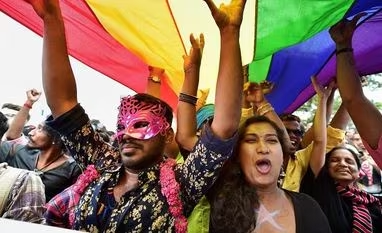
Gay sex now legal in India; Supreme Court strikes down section 377

Section 377 was modelled after the 16th century Buggery Act of Britain
section 377
Homosexual relations are legal in 25 countries besides India
Business Standard
Last Updated : Sep 07 2018 | 2:58 AM IST
A five-judge Constitution Bench of the Supreme Court on Thursday unanimously decriminalised part of the 158-year-old Section 377 of the Indian Penal Code, which criminalised consensual “unnatural sex”. 

A landmark judgment

‘Irrational, indefensible, manifestly arbitrary’

The LGBTQ community possesses the same constitutional rights as other citizens, said the 493-page judgment of the Bench headed by Chief Justice Dipak Misra

‘A biological phenomenon… natural’

In the world

Homosexual relations are legal in 25 countries besides India. But 72 nations and territories continue to criminalise it. In 45 such places, same-sex relations between women are also outlawed 

The petitioners

A batch of writ petitions was filed by dancer Navtej Johar, journalist Sunil Mehra, chef Ritu Dalmia, hoteliers Aman Nath and Keshav Suri, business executive Ayesha Kapur, and 20 students of the IITs

What this judgment means

Other aspects of the law, which criminalises non-consensual sexual acts, bestiality, and “unnatural” sex with animals, will remain in force. Same-sex civil union is still not allowed, though the law commission has recently advocated it


The road to equal rights

Section 377 was modelled after the 16th century Buggery Act of Britain
  • July 2, 2009: The Delhi High Court (HC) legalised consensual same-gender sex for adults
  • 2013: A two-judge SC Bench of G S Singhvi and S J Mukhopadhaya overturned the HC judgment, claiming fewer than 200 people had been prosecuted under the law
  • 2015: Congress Lok Sabha member Shashi Tharoor disallowed by fellow parliamentarians from introducing a private member’s Bill to decriminalise homosexuality
  • 2017: A nine-member SC Bench, ruling on the right to privacy, criticised the 2013 judgment
What the SC bench said

‘I am what I am. So take me as I am... Denial of self-expression is like death’, said Dipak Misra, Chief Justice of India, quoting German writer Goethe.

‘History owes an apology to the members of this community and their families’, said Justice Indu Malhotra.

‘The tragedy and anguish which Section 377 inflicts must be remedied’, said Justice D Y Chandrachud

One subscription. Two world-class reads.

Already subscribed? Log in

Subscribe to read the full story →
*Subscribe to Business Standard digital and get complimentary access to The New York Times

Smart Quarterly

₹900

3 Months

₹300/Month

SAVE 25%

Smart Essential

₹2,700

1 Year

₹225/Month

SAVE 46%
*Complimentary New York Times access for the 2nd year will be given after 12 months

Super Saver

₹3,900

2 Years

₹162/Month

Subscribe

Renews automatically, cancel anytime

Here’s what’s included in our digital subscription plans

Exclusive premium stories online

  • Over 30 premium stories daily, handpicked by our editors

Complimentary Access to The New York Times

  • News, Games, Cooking, Audio, Wirecutter & The Athletic

Business Standard Epaper

  • Digital replica of our daily newspaper — with options to read, save, and share

Curated Newsletters

  • Insights on markets, finance, politics, tech, and more delivered to your inbox

Market Analysis & Investment Insights

  • In-depth market analysis & insights with access to The Smart Investor

Archives

  • Repository of articles and publications dating back to 1997

Ad-free Reading

  • Uninterrupted reading experience with no advertisements

Seamless Access Across All Devices

  • Access Business Standard across devices — mobile, tablet, or PC, via web or app

Next Story


