
Global sea levels may rise by 2300 if greenhouse gas emissions remain high
Beyond 2050, projections are more sensitive to changes in greenhouse gas emissions and to the approaches for projecting sea-level change
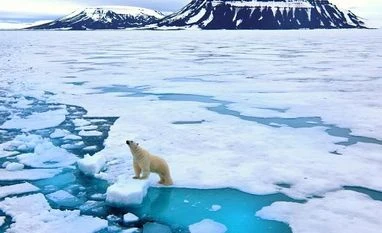 "Global sea levels may rise by 2300 if greenhouse gas emissions remain high")
Explore Business Standard
Beyond 2050, projections are more sensitive to changes in greenhouse gas emissions and to the approaches for projecting sea-level change
Global average sea-level could rise by nearly eight feet by 2100 and 50 feet by 2300 if greenhouse gas emissions remain high, posing a major risk to coastal populations and ecosystems around the world, according to a study.
Since the start of the century, global average sea-level has risen by about 0.2 feet, said researchers at the Rutgers University in the US.
Under moderate emissions, central estimates of global average sea-level from different analyses range from 1.4 to 2.8 more feet by 2100, 2.8 to 5.4 more feet by 2150 and 6 to 14 feet by 2300, according to the study published in the journal Annual Review of Environment and Resources.
With 11 per cent of the world's 7.6 billion people living in areas less than 33 feet above sea level, rising seas pose a major risk to coastal populations, economies, infrastructure and ecosystems around the world, the researchers said.
Sea-level rise varies over location and time, and scientists have developed a range of methods to reconstruct past changes and project future ones.
However, despite the differing approaches, a clear story is emerging regarding the coming decades, researchers said.
From 2000 to 2050, global average sea-level will most likely rise about 6 to 10 inches, but is extremely unlikely to rise by more than 18 inches, they said.
Beyond 2050, projections are more sensitive to changes in greenhouse gas emissions and to the approaches for projecting sea-level change.
"There's much that's known about past and future sea-level change, and much that is uncertain. But uncertainty isn't a reason to ignore the challenge," said Robert E Kopp, a professor at Rutgers University.
"Carefully characterising what is known and what is uncertain is crucial to managing the risks sea-level rise poses to coasts around the world," Kopp said.
Scientists used case studies from Atlantic City, New Jersey, and from Singapore to discuss how current methods for reconstructing past sea-level change can constrain future global and local projections.
They also discussed approaches for using scientific sea-level projections and how accurate projections can lead to new sea-level research questions.
A large portion of sea-level rise in the 20th century, including most of the global rise since 1975, is tied to human-caused global warming, resaerchers said.
First Published: Oct 08 2018 | 3:20 PM IST

