Monkey business: These men are paid to mimic langurs
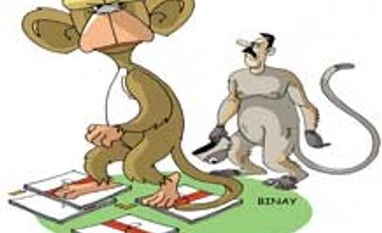
Government employs 40 people to behave like the primates hoping this would scare away monkeys in New Delhi area
BS Reporter New Delhi Forty young men “impersonating” as langurs currently protect our public representatives from the troops of monkeys that terrorise Members of Parliament and officials inside Parliament House, and other important buildings like the Supreme Court in the New Delhi area of the national capital.
Minister of Urban Development M Venkaiah Naidu on Thursday told the Rajya Sabha that New Delhi Municipal Council (NDMC) has hired “40 young” people for the purpose of scaring away monkeys. In a reply to a question from Bahujan Samaj Party MP Ambeth Rajan, Naidu said the 40 men were “trained persons who disguise themselves as langurs”.
Grey or Hanuman langur is the natural enemy of the monkey. Monkeys are ubiquitous in and around Delhi, particularly near the broad leafy avenues of New Delhi and many of its British- era buildings.
Naidu’s reply in Parliament and a press release from the Press Information Bureau of the government seemed to suggest that the young men dress up as langurs to drive away monkeys. The truth, an NDMC official said, was less strange. He said the civic authority had employed men who mimic langurs to frighten the monkeys away.
The official, who preferred not to be quoted lest he is seen making a monkey out of the minister’s statement, said the civic authority would, until a year ago, hire langurs along with their caretakers to drive away monkeys. It was a common sight in Delhi’s buildings to see a langur tied to a long rope being prodded by its caretaker to chase away monkey hordes. The langur and his caretaker had become an important part of the administration and would get their two weekly holidays and did eight-hour work shifts with an hour of lunch break. The practice had to be stopped after the langur species was included in Schedule II of the Wildlife Protection Act, 1972.
In end-2012, the ministry of environment and forests wrote to all government departments that owning, trading, buying or hiring out of langurs was an offence punishable under the law and entailed a prison term of up to three years or a fine or both. The practice did continue but mostly surreptitiously. This also changed once the new regime took over, with Maneka Gandhi, an animal rights activist, being part of the Cabinet.
The men, according to the NDMC official, were hired some months back during the fag end of the UPA regime. These men have been hired on contract and earn minimum wages, that is approximately Rs 8,000 a month.
Each of these men is armed with his ability to mimic langurs and a stick. The civic official expressed ignorance about the educational qualifications of these men, or whether any qualification test was conducted before recruiting them. “We are yet to open a training academy for people to be imparted the art of scaring monkeys,” he said.
Naidu also told Parliament that NDMC had acquired ‘Sure Shot Rubber Bullet Guns’ to scare away monkeys, and that a team of dog catchers visits the Parliament House and surrounding areas twice a week to catch stray dogs that are not immunised and sterilised.
The official assured the rubber bullets wouldn't kill or injure any monkeys, and were perfectly safe.
Naidu had replied to the BSP MP’s question whether the government was aware of the monkey and stray dog menace across Delhi, particularly in and around Parliament House. He also wanted to know what steps the government had taken to tackle this menace. Incidentally, BSP has ‘elephant’ as its election symbol.
Rajan said he had personally faced problems because of the presence of monkeys at his government-allotted apartment on North Avenue. Recently, a monkey broke into his rooftop water tank. "It was swimming in the tank," Rajan said, adding his slogan was 'Make Delhi a monkey-free capital' and that the problem needed a permanent remedy. Rajan said he disagreed with animal rights activists like Maneka Gandhi. "We all love animals. Dogs can be handled but the place for these monkeys is a jungle. We are wasting money by training humans to scare away monkeys. The simians should be caught and released in a jungle," he said.
Delhi Fire Service and civic officials, however, said the strategy to employ humans hasn’t been particularly successful given their limited ability, unlike langurs, to scale walls and trees. Complaints of monkey menace from MPs, judges and senior bureaucrats are frequent. Most relate to monkeys vandalising kitchen gardens, carrying away food items, snapping phone or television wires and tearing clothes left in the open for drying.

 "Monkey business: These men are paid to mimic langurs")

