After its success in developing a basic trainer aircraft, Hindustan Aeronautics Ltd (HAL) on Wednesday flew its Intermediate Jet Trainer (IJT) after an extensive redesign that took almost three years.
“The flight was flawless and its success is an important step in the IJT programme”, announced HAL on Thursday.
The success of the IJT – also called the Hindustan Jet Trainer – 36, or the Sitara – is crucial for both HAL and the Indian Air Force (IAF). For cash-strapped HAL, building 73 IJTs will mean business worth Rs 5,000 crore.
The IJT would seemlessly replace a fleet of obsolescent Kiran Mark I and II trainers that are already on borrowed time. Without the HAL-built trainer, the IAF will have no aircraft for the intermediate stage of flying training. Late last year, the IAF decided that its rookie pilots, after completing “Stage-1” flying training on the Pilatus PC-7 Mark II basic trainer, would graduate directly to “Stage-3” training on the Hawk advanced jet trainer (AJT). HAL manufactured the Hawk AJT fleet in Bengaluru, under licence from BAE Systems.
The IAF realises that “two-stage” training places unrealistic demands on trainee pilots The successful development and quick manufacture of the IJT would allow its time tested “three-stage” training to continue.
That would also mean HAL aircraft are used in all three stages of IAF flight training. HAL’s basic trainer, the Hindustan Turbo Trainer – 40 (HTT-40), is doing well in flight testing and is expected to join the fleet alongside the Pilatus PC-7 Mark II trainer.
However, the IJT’s development trajectory has been troublesome. In 2016, flight testing was put on hold after the trainer experienced difficulty in pulling out of spins – something that inexperienced pilots cannot be exposed to.
In December that year, the IAF requested that the IJT project be shut down. However, HAL asked the defence ministry (MoD) for time to rescue the programme. HAL offered to return the IAF the Rs 3,000 crore it had paid towards an order of 73 IJTs. HAL’s board allocated Rs 50 crore in company funds to take forward the IJT’s development, supplementing the Rs 600-700 crore it had already spent.
Senior HAL sources told Business Standard the IJT has undergone an extensive two-year redesign process, guided by design consultancy from US firm Birhle to help the aircraft pull out of spins. This was achieved by shifting the horizontal fins and rudder further down the fuselage. Now, mathematical modelling indicates the redesigned IJT is well equipped to handle spins.
“HAL continued its R&D efforts and undertook modification of IJT aircraft based on extensive and comprehensive wind tunnel studies”, affirms HAL chief R Madhavan.
“We will have to conduct at least another 200 test flights to validate the IJT, including its stall and spin characteristics. But we have built 13 aircraft already and we can finish this without undue delay,” says a senior HAL designer.
HAL designers also say many useful lessons have been learnt from the development of the HTT-40 basic trainer. That expertise is now being fed back into the IJT.
An example of this is HTT-40’s modern all-glass cockpit, which will be retro-fitted into the IJT. In addition, safety equipment for stall and spin testing being used in the HTT-40 will also be used for the IJT.

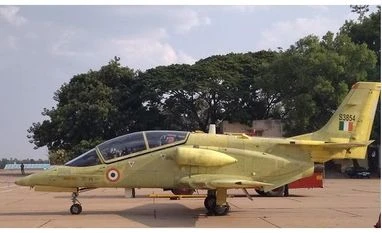 "HAL's Intermediate Jet Trainer flies again after extensive re-design")












 Connect with us on WhatsApp