Health ministry says no third dose booster planned, focus is on second jab

Urges states to speed up second shot for healthcare workers
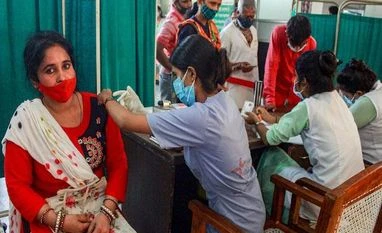
Coronavirus vaccine, Covid-19 vaccine,
A health worker administers a dose of COVID-19 vaccine to a beneficiary, at Government Polyclinic vaccination centre in Gurugram (Photo: PTI)
Sohini Das Mumbai
4 min read Last Updated : Oct 01 2021 | 12:02 AM IST
Clearing the air on whether a booster vaccine dose will be given after two doses, the country’s apex health research institute said that a there were no such plans. Moreover, the Ministry has now urged states where many healthcare workers have not yet got their second dose vaccine to speed up the process by using line-lists generated by the Co-WIN platform.

Speaking to the media, Balram Bhargava, director general of the Indian Council of Medical Research (ICMR) said that studies in India have also found that more than 95 per cent of the antibodies (generated due to vaccination) persist for over a year.

Bhargava said: “Currently, the talk of booster is not pertinent. The call of the hour is to give the two-dose vaccination, or which is the full vaccination. That is our agenda and that has to be continued.”

He further added that “We have had some studies in India, including Bangalore, where some hospitals have found that more than 95 per cent of the antibodies persist for over a year. Therefore, the talk of booster dose is not pertinent.”

Meanwhile, around 85 per cent of healthcare workers have got their second Covid-19 vaccine dose, even though the healthcare worker vaccination was prioritised by India. Around 99 per cent of them have got their first dose compared to 100 per cent frontline workers who have received their first shot.

Health secretary Rajesh Bhushan said that they have indeed taken up the matter with concerned states where second dose vaccination rates among healthcare workers has been low. “There is a facility in the CoWin system where line-listing of people who have missed their second dose can be done. So, states have got those lists, and they are looking into it that these people can be given the second dose,” he added.

There have been reports of irregularities with regards to vaccinations–like dead people getting vaccines, or delayed data entry. The Health Ministry cleared the air on the matter.

“The allegation of delayed data entry was made with respect to Bihar. We got it checked and found it to be absolutely baseless. Bihar, on an average, inoculates 3-5 lakh people a day. To expect that one will inoculate 3-5 lakh people a day and not give them digital certificates, they will not get messages, not upload that data, would be something totally unrealistic. We have asked the concerned media houses who had done the story if they could share specific details of villages and people, and then we can check those claims,” Bhushan explained.

As far as dead people being given vaccines is concerned, that was an instance reported in Madhya Pradesh. “We found that the registration was done when the person was alive, and on the date the person would have got the vaccine, unfortunately he died. There was an inadvertent error by the vaccinator in pressing the button against his name. It has been subsequently corrected,” he clarified.

India working actively on a new dengue vaccine

Balram Bhargava , director general of the Indian Council of Medical Research (ICMR) said that developing a dengue vaccine is an important agenda. “Several dengue strains have been licensed to various companies in India. We are working very closely with them to do the trials. Many of these companies have done trials outside the country, and now we are planning to do more rigorous trials with these dengue vaccines,” he added.

Meanwhile, on the matter Emergency Use license (EUL) for indigenous vaccine Covaxin developed jointly by the ICMR and Bharat Biotech, Bhargava said “We know that scientific data, public health considerations and international health requirements are all considered on which an EUL is given by the World Health Organisation (WHO). All these have been provided, and based on these the WHO will decide accordingly.”

One subscription. Two world-class reads.

Already subscribed? Log in

Subscribe to read the full story →
*Subscribe to Business Standard digital and get complimentary access to The New York Times

Smart Quarterly

₹900

3 Months

₹300/Month

SAVE 25%

Smart Essential

₹2,700

1 Year

₹225/Month

SAVE 46%
*Complimentary New York Times access for the 2nd year will be given after 12 months

Super Saver

₹3,900

2 Years

₹162/Month

Subscribe

Renews automatically, cancel anytime

Here’s what’s included in our digital subscription plans

Exclusive premium stories online

  • Over 30 premium stories daily, handpicked by our editors

Complimentary Access to The New York Times

  • News, Games, Cooking, Audio, Wirecutter & The Athletic

Business Standard Epaper

  • Digital replica of our daily newspaper — with options to read, save, and share

Curated Newsletters

  • Insights on markets, finance, politics, tech, and more delivered to your inbox

Market Analysis & Investment Insights

  • In-depth market analysis & insights with access to The Smart Investor

Archives

  • Repository of articles and publications dating back to 1997

Ad-free Reading

  • Uninterrupted reading experience with no advertisements

Seamless Access Across All Devices

  • Access Business Standard across devices — mobile, tablet, or PC, via web or app

Topics :CoronavirusCoronavirus VaccineICMR

Next Story



