How A-SAT can destroy enemy's ability to use space technology against India

This capability will deny any adversary, the use of satellites and other space-crafts, as a platform for any offensive operations against India
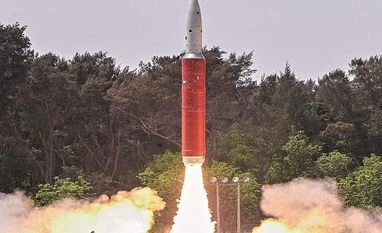
Ballistic Missile Defence Interceptor missile being launched by DRDO from Odisha on Wednesday 	photo: PTI
Ballistic Missile Defence Interceptor missile being launched by DRDO from Odisha on Wednesday | Photo: PTI
T E Narasimhan Chennai
4 min read Last Updated : Mar 28 2019 | 9:34 AM IST
India on Wednesday made its way into an elite club of "space super powers" as its anti-satellite missile A-SAT shot down a live satellite on a low earth orbit, at a distance of 30 km,  in just three minutes. So far only three countries - the US, Russia and China -- had this technology.

'Mission Shakti' is a breakthrough in technology and the country has demonstrated its capability to interdict and intercept a satellite in outer space based on  indigenous technology, said experts. 

An External Affairs Ministry statement said the target satellite was one of India's existing satellites operating in lower orbit.

"The test was fully successful and achieved all parameters as per plans. The test required an extremely high degree of precision and technical capability. The significance of the test is that India has tested and successfully demonstrated its capability to interdict and intercept a satellite in outer space based on complete indigenous technology," it said. "The capability achieved through the A-SAT test provides credible deterrence against threats to our growing space-based assets from long range missiles, and proliferation in the types and numbers of missiles," it said.

In an interview, former Isro Chairman, G Madhavan Nair said that China, USA and Russia have already demonstrated their capability. India has conducted the satellite test with all safety precautions. "This is a breakthrough in technology," he added.

Ratan Shrivastava, advisor (space division), Federation of Indian Chambers of Commerce and Industry (FICCI) said that for India to develop the capability of ASAT through "Mission Shakti"  is a strategic weapon, which can be used in to intercept and interdict, deny and destroy the ability of the enemy to use their space based systems for gathering intelligence, military applications and deny the use of satellites and other spacecrafts as a platform for any offensive operations against India by targeting the adversary country's surveillance, communication and military satellites.

It assumes importance as there is a vital need to have deterrence in the vital fourth dimension of space to safeguard and defend the country's considerable space assets - and deny the enemy nation access to space assets against India.

ASATs can render the enemy navigation and communication systems useless.

India has had a robust missile defense program and it is a signatory to all the major treaties in relation to outer space through UN Space Committee and others.
 
"The military potential of satellites are several – such as surveillance, communications, navigation, early warning and can provide for continuous intelligence and monitoring adding the vital fourth dimension as a credible deterrent and a force multiplier, in addition to the Land, Sea and Air, in case of a conflict, specially, when long drawn out wars may give way to shorter and intense conflicts in the future," said Shrivastava.

This capability will deny any adversary the use of satellites and other space-crafts, as a platform for any offensive operations against India by targeting the adversary country’s surveillance, communication and military satellites. It will also safeguard and defend India’s  space assets.

ASATs can render the enemy navigation and communication systems useless as a resource and platform to use their air and missile assets against India. ASAT operations are technically challenging and highly complex . The complexity of the mission can be understood by the fact that India hit a satellite orbiting at 300 kilometers above the earth, travelling at a speed of 29000 kilometers per hour – to find and locate the correct satellite, in a maze of space objects field and debris. Successfully destroying it in 3 minutes is nothing short of splendid and spectacular precision displayed by Indian scientists of ISRO and DRDO, said Shrivastava.

One subscription. Two world-class reads.

Already subscribed? Log in

Subscribe to read the full story →
*Subscribe to Business Standard digital and get complimentary access to The New York Times

Smart Quarterly

₹900

3 Months

₹300/Month

SAVE 25%

Smart Essential

₹2,700

1 Year

₹225/Month

SAVE 46%
*Complimentary New York Times access for the 2nd year will be given after 12 months

Super Saver

₹3,900

2 Years

₹162/Month

Subscribe

Renews automatically, cancel anytime

Here’s what’s included in our digital subscription plans

Exclusive premium stories online

  • Over 30 premium stories daily, handpicked by our editors

Complimentary Access to The New York Times

  • News, Games, Cooking, Audio, Wirecutter & The Athletic

Business Standard Epaper

  • Digital replica of our daily newspaper — with options to read, save, and share

Curated Newsletters

  • Insights on markets, finance, politics, tech, and more delivered to your inbox

Market Analysis & Investment Insights

  • In-depth market analysis & insights with access to The Smart Investor

Archives

  • Repository of articles and publications dating back to 1997

Ad-free Reading

  • Uninterrupted reading experience with no advertisements

Seamless Access Across All Devices

  • Access Business Standard across devices — mobile, tablet, or PC, via web or app

Next Story



