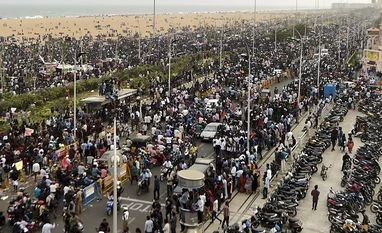
The unprecedented youth upsurge in Tamil Nadu, controlled and non-violent, against the ban on Jallikattu, the bull-taming sport staged during the festival of Pongal in January, could well be one of the most successful mass movements in the country.
The sport was banned by the United Progressive Alliance government in 2011 on grounds of cruelty to animals. In May 2014, the ban was reinforced by the Supreme Court, stating that bulls cannot be used as performing animals, including in bullock-cart races.
This touched a raw nerve in Tamil Nadu, as people felt that their culture was being trampled upon, and thousands of students took to the streets and camped at locations like Marina Beach in Chennai for more than five days this week, unwilling to relent till the state and central governments took steps to revoke the ban.
On Friday night, the Centre cleared an ordinance on Jallikattu, paving the way for Tamil Nadu to promulgate it and resume the ancient sport. Arrangements are under way at Alanganallur in the Madurai district to hold Jallikattu on Sunday.
Prime Minister Narendra Modi tweeted: “All efforts are being made to fulfil the cultural aspirations of Tamil people.”
Animal rights activists, who had asked for the ban, are conspicuously quiet on the whole affair — such has been the surge of public opinion. People for the Ethical Treatment of Animals (PETA), which is under fire ever since the agitation started, said it will consult with its lawyers and proceed based on their advice.
The NGO says it was not the only one to file the petition against Jallikattu — it started when one Nagaraja, whose son was killed by a bull in 2004, filed a petition. Then Animal Welfare Board of India (formed by the Union environment ministry) was also involved in the litigation. PETA got into the case only in 2011 when, despite regulations, abuse of bulls was taking place during Jallikattu.
Vaiko, the general secretary of Marumalarchi Dravida Munnetra Kazhagam and a firebrand supporter of all issues Tamil, says the upsurge amongst students and youngsters is unprecedented — even the spate of farmer suicides and notebandi had failed to arouse them. That the support for Jallikattu comes in the midst of a drought shows how emotive the issue has become.
“I am actually happy with the protest. For the past two years, I have been talking about such a movement and it is finally happening,” says former Union minister and PMK leader Anbumani Ramadoss.
Jallikattu protests are remarkable as it means the coming together of all Tamil Hindus for the first time, says MR Venkatesh, a chartered accountant and political commenter.
The students, on their part, are making sure the protest is not hijacked by any political party. They have cold-shouldered leaders like MK Stalin, the opposition leader and working president of the Dravida Munnetra Kazhagam (DMK). The ruling All India Anna Dravida Munnetra Kazhagam (AIADMK) is trying its best to bring a solution to the issue, which otherwise could turn against its government. Various other political parties are supporting the protest.
Tamil stars join in
On Friday, many of the private transport vehicles stopped their service and majority of the shops across the state downed shutters to support the cause. Transporters grounded their half a million trucks and cinema halls refused to play movies during the day in solidarity with the protesters. Southern Railway cancelled five trains and shortened a couple of others. Colleges were shut indefinitely.
Actors, under the banner of Nadigar Sangham (South Indian Actors’ Association), including superstars Rajinikanth, Kamal Haasan, Surya and Vijay, joined the protest in T Nagar and restricted the media from covering the event in order to ensure attention was not diverted from the protesting youngsters. Music Director A R Rahman went on fast to support Jallikattu.
In Jallikattu, the bulls are led through a small gate (Vaadi Vasal) to a path cordoned by wooden fence and local lads try to conquer the bull by holding on to its hump for a certain distance or for a minimum number of jumps.
Animal lovers say the bull responds to any adverse situation by putting up a fight. They claim that people force the bull out of the gate by biting and bending its tail. They cut off the thick rope which passes through its nostrils, which results in pain. Like humans, they too feel pain, trauma, fear and affection.
Over the years, malpractices like feeding the bull liquor or putting chilli power into its nose or sharpening the horns of the bull to make it dangerous and unconquerable have crept into the rural sport, say people.
Mailini Parthasarathy, former editor of The Hindu, says while humans voluntarily participate in those sports, animals have no voice or choice. Accidents, minor and major, can occur and often do occur, as the panicked bull crushes its way through the crowd when the gate is thrown open.
Owners spend around Rs 500 a day on the bull. These bulls are only used for Jallikattu. Those who conquer the bull were earlier rewarded with bronze trophies and prices, and are now given appliances like food processors or steel almirahs. It is a matter of pride for those who conquer the bull and also those whose bull stays unconquered.
From 2002, Jallikattu was conducted under the supervision of the state government, which ensured the bulls and the participants were checked for their fitness and measures were taken to make the event less violent — for the participants as well as the bulls.
Sensing the public opinion, in January 2015, the Tamil Nadu government had requested Prime Minister Modi’s personal intervention to enable Jallikattu by removing bulls from the list of performing animals in the notification dated July 11, 2011, issued by the Union ministry of environment and forests, and to amend the Prevention of Cruelty to Animals Act, 1960, by exempting Jallikattu.
The Centre issued a notification on January 7, which was expected to enable Jallikattu during Pongal. However, it was stayed by the Supreme Court, though in some places people nevertheless tried to conduct it.
Becoming a mass movement
The event did not take place officially during Pongal in the last three years. This year, a group of people supporting Jallikattu sat in protest at Alanganallur on Monday, after unleashing some of the bulls despite the Supreme Court order. The cops foiled the plan by taking the bulls into custody and arrested those who were protesting.
The arrest triggered sporadic protest in various parts of the state, with college students and youngsters gathering in open spaces, raising the demand to revoke the ban and censure PETA.
As the protests spread, Chief Minister O Panneerselvam flew to Delhi and met Prime Minister Modi who did not offer any immediate remedy since the matter was sub judice. This came as a shot in the arm for the protesters, who rapidly gained popular support and flocked to Marina Beach. Milk, tea, pongal and idlis were distributed to protesters free of cost. All roads to the Marina Beach were blocked for public transportation and rehearsals for the Republic Day Parade could not be held on Beach Road.
With protest growing against the central government and PETA, Panneerselvam stayed back in Delhi for another day and mooted a draft ordinance which received approval from the Union law ministry on Friday night.
However, legal experts and some protesters point out that an ordinance has validity only for six months and given that the next Jallikattu is expected in January 2017, this will not be a permanent solution. The only way out is to amend the PCAA and the centre is not committing to this, they say.
Amidst the protest, a conspiracy theory is floating around PETA, the animal lovers’ forum which has its roots overseas. Banning Jallikattu will discourage people from rearing the native breed of bulls, some people say. The buzz on the social media about the import of Jersey cows has fuelled such theories. The live cargo — of 60 Jersey cows — from Switzerland arrived at Chennai airport on Wednesday night, reports said. This was the first batch of 540 such animals which are to be imported by the National Diary Development Board for Tamil Nadu.
There were 130 or more cattle breeds in India 100 years ago and now there are only 37, say Jallikattu supporters who aver that unless these remaining breeds are preserved and protected, they would go extinct. However, PETA members deny the allegations and say the demand to ban the organisation is foolish.
While most social and political analysts support the cause, Gnani Sankaran, Tamil writer and social activist, says the protest is state sponsored. “When a group of around 50 people protested against demonetisation, they were brutally beaten by the police a month back. Now, we can see them supporting the protesters.” This, he says, is to divert attention from the rising resentment against the new AIADMK chief, Sasikala Natarajan. The issue is not real, he adds, because Jallikattu is practised in only three districts of Tamil Nadu.
While the state government is taking all efforts to douse the fire, the issue could snowball if the Supreme Court orders against the sport again.
The debate goes on
- 2006: The Madras High Court bans Jallikattu and bullock cart race
- 2009: Tamil Nadu government passes the Tamil Nadu Regulation of Jallikattu Act (TNRJA). The Act allows jallikattu for five months in a year
- November 2010: The Supreme Court gives conditional permission to Jallikattu
- July 2011: The Union environment ministry bans the use of bulls as performing animals, effectively banning Jallikattu
- May 2014: The Supreme Court strikes down TNRJA, bans Jallikattu
- January 2016: The BJP government allows Jallikattu and bullock cart race in Tamil Nadu, Maharashtra, Karnataka and Gujarat subject to certain conditions
- July 2016: The Supreme Court overturns the BJP government’s decision following a petition by PETA and Animal Welfare Board
- December 2016: Protests start in Tamil Nadu against the ban
- January 14, 2017: Students come out in large numbers against the ban at Chennai’s Marina Beach
- January 20, 2017: Centre clears Tamil Nadu government’s ordinance on Jallikattu