Imran Khan: The man who caught the Prime Minister's attention
In his Wembley speech in London, Prime Minister Modi said, "My India resides in people like Imran Khan from Alwar"
Dhruv Munjal On a crisp Wednesday morning, there are no onlookers around Imran Khan’s modest house in Alwar’s little-known locality of Laxmi Nagar. An unassuming iron gate opens into a vast courtyard that is largely empty, barring two plastic chairs neatly placed in one corner. The windows are rusty and the paint unexceptional. His wife, Kashmiri, dressed in a white floral salwar kameez, greets me. “He’s at school. Very rarely does he miss school. He loves teaching kids,” she says with a smile. Ruben, Khan’s nephew, calls up his uncle and checks if I can go and meet him at his school. “You can go there. He will happily meet you,” he says.
Khan, 36, teaches maths to primary classes at the Upper Primary Sanskrit School on the other side of town. He remarkably found mention in Prime Minister Narendra Modi’s Wembley speech in London last week. “My India resides in people like Imran Khan from Alwar,” the prime minister said in front of 80,000 people. His phone hasn’t stopped ringing since. Khan has developed more than 50 educational apps for students across all classes in the last three years. What makes his achievement so astounding is that he has never received any formal training in computers or programming.
At his school — nestled in the foothills of the Aravallis — Khan enjoys the status of a mini-celebrity. A beaming Khan meets me inside one of the classrooms. The tiny room, packed with class III students, is slowly filled with ripples of raucous laughter. Outside, children are playing volleyball on a barren strip of grass even as a worker off-loads cartons stacked with packets of Midday meals from a van.
“The kids are playing games on the computer. So, we can talk now,” says Khan, dressed in a white shirt and blue trousers. Much before he caught Modi’s attention, Khan’s work was first noticed by Alwar’s district collector, Ashutosh Padnekar. In 2012, he designed a website called gktalk.com which, interestingly, gave tips to students on how they can design their own website. Little did Khan know that his website was garnering more 60,000 hits every day soon after its launch. “The district collector called me and told me that the website was doing well. He was the one who asked me to start designing apps,” he reminisces.
With little programming knowledge, Khan took to the internet to understand how apps are developed. “I remember how I didn’t even know what an app was. I had to take the help of the internet to learn all these things,” he says. Today, Khan is proficient at both PHP and JavsScript. His general science app for class IX students has been downloaded more than 600,000 times on the Google Play Store. Till very recently, it was among the top five most downloaded apps in the country. “The language that I use is very simple. So, the subject is easy to understand, he says. “The science app, for example, uses ordinary language to explain daily science phenomena.”
Rani, an 8-year-old student of Khan’s, shows me how to operate “Bal Guru”, a student-teacher interface developed by Khan that allows the school to comprehensively evaluate its students’ performance. “I upload questions for all subjects after every class. The students can take a quiz of what they’ve learnt almost immediately,” he says proudly. In rural India, where technology is still growing at a tardy rate, Khan seems well ahead of his time. Unsurprisingly, the black board behind him has the words “Digital Child, Digital India” written on it with white chalk.
Despite all the adulation that has come his way in the last few days, Khan remains humble. “My contribution is very little. My goal is simple: improve the quality of education and give more students access to study material. This is a start but there is some way to go,” he says. As I take his leave, Khan and his students jocundly pose for the camera one last time. “This is enough fun for today. They better go back to studying now,” he says, signing off.

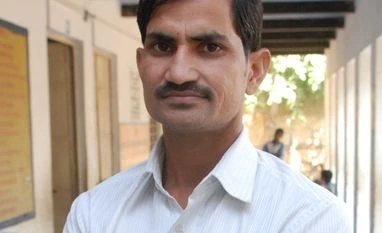 "Imran Khan: The man who caught the Prime Minister's attention")


 Connect with us on WhatsApp