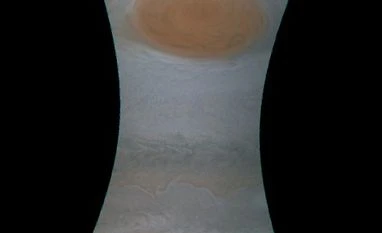
In Pics: First images of the Great Red Spot- a fiery storm on Jupiter
The Great Red Spot is a 16,000-kilometre-wide storm that has been monitored since 1830
Press Trust of India Washington NASA's solar-powered Juno spacecraft has successfully completed the closest flyby of Jupiter's iconic Great Red Spot - a massive storm that has been raging on the giant planet for over 350 years.
All of Juno's science instruments and the spacecraft's JunoCam were operating during the flyby, collecting data that are now being beamed back to Earth.
This enhanced-color image of Jupiter’s Great Red Spot was created by citizen scientist Gerald Eichstädt using data from the JunoCam imager on NASA’s Juno spacecraft. Photo: Twitter
Raw images from the spacecraft's latest flyby will be posted in coming days, NASA said.
"For generations, people from all over the world and all walks of life have marvelled over the Great Red Spot," said Scott Bolton, principal investigator of Juno from the Southwest Research Institute in San Antonio.
"Now we are finally going to see what this storm looks like up close and personal," Bolton said.
Photo: Twitter
The Great Red Spot is a 16,000-kilometre-wide storm that has been monitored since 1830 and has possibly existed for more than 350 years.
In modern times, the Great Red Spot has appeared to be shrinking.
Juno reached perijove - the point at which an orbit comes closest to Jupiter's centre - on July 10.
At the time of perijove, Juno was 3,500 kilometres above the planet's cloud tops.
Eleven minutes and 33 seconds later, Juno covered another 39,771 kilometres, and passed directly above the coiling crimson cloud tops of the Great Red Spot.
The spacecraft passed about 9,000 kilometres above the clouds of this iconic feature.
On July 4, Juno logged one year in Jupiter orbit, marking 114.5 million kilometres of travel around the giant planet.
Juno launched on August 5 in 2011. During its mission of exploration, Juno soars low over the planet's cloud tops - as close as about 3,400 kilometres.
During these flybys, Juno is probing beneath the obscuring cloud cover of Jupiter and studying its auroras to learn more about the planet's origins, structure, atmosphere and magnetosphere.
Early science results from NASA's Juno mission portray the largest planet in our solar system as a turbulent world, with an intriguingly complex interior structure, energetic polar aurora, and huge polar cyclones.
(Only the headline and picture of this report may have been reworked by the Business Standard staff; the rest of the content is auto-generated from a syndicated feed.)

 "In Pics: First images of the Great Red Spot- a fiery storm on Jupiter")


