Home / Health / India Coronavirus Dispatch: How the lockdown upended Adivasi communities
India Coronavirus Dispatch: How the lockdown upended Adivasi communities
Young women are bearing the brunt of the pandemic, how researchers are getting by, and virus spike proteins imaged in their natural state-news relevant to India's fight against Covid-19
premium
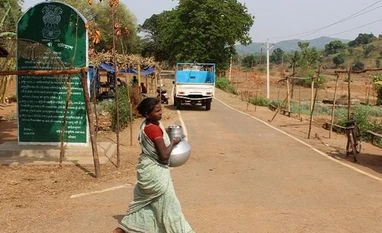
A woman passes the stone erected at the village crossing. | Photo: Ankur Paliwal
4 min read Last Updated : Dec 21 2020 | 3:25 PM IST
India’s unplanned lockdown unleashed fresh hell for its Adivasis
The lockdown imposed in March took the general public by surprise and several sections of society were reeling from it for months. The Adivasis and other forest-dwelling communities, which at 104 million individuals make up 8.6% of the population, were particularly hard hit.
Since the Adivasi communities live in remote areas, information about the disease was not adequately available, to begin with. These communities who have been marginalised in terms of access to healthcare were badly hit as Covid-19 impacts people with compromised health conditions and low immunity. A complete lockdown, restricted entry to forests and closed markets are all factors that have increased their vulnerability as they depend on the forests for their livelihoods and several other purposes. The absence of government support worsens their position, the writer of the article says.
Adivasi communities are also heavily dependent on agriculture. However, in the past decade, the number of agricultural labourers grew by 9%, while the number of Adivasi cultivators has contracted by 10%. This meant many found it hard to access either agricultural or non-agricultural livelihood options during the lockdown, the writer says. Read more here
Young women are bearing the brunt of pandemic disruption
The Covid-19 pandemic has likely upended millions of lives in India. However, women are bearing the brunt of the disruption and the repercussions could take a long time to reverse.
According to a recent study released by LinkedIn, based on internal data for India, women’s participation in the labour force actually rose by 7% between April and July. However, this applied only to a small demographic of women—the urban and the educated. This also applies only to jobs in the formal, white-collar, urban economy, which makes a fraction of the labour market, the writer of this article says.
For most Indian women, the situation is deeply worrying. Especially, young women in their early 20s. According to CMIE data, by the end of 2019, young women were starting to recover from the twin shocks of demonetization in 2016 and the introduction of GST in 2017. Their workforce participation rate which had climbed up to 14.3%, has shrunk that rate to 8.7% in the current recession, the writer says. Read more here
How researchers are getting by amid the pandemic
While research around Covid-19 has taken place at a rapid pace, non-coronavirus research meanwhile has suffered.
Many researchers struggled to sustain their research programs with labs and offices shut. Their fieldwork and experiments were postponed. Many took the opportunity to catch up on writing grants and papers. Some came up with workarounds to keep the scientific juices flowing, the writer of the article says.
Here are a few slices of scientific life during the pandemic. Among them is a specialist keeping alive genetically important strains of fruit flies, and a paediatrician struggling to manage clinical trials for a rare genetic disease, the writer says. Read more here
Study points to benefits of indomethacin in Covid-19 care
A study conceived by Rajan Ravichandran, senior nephrologist, MIOT Hospital in Chennai, and executed along with R. Krishnakumar of the Department of Engineering Design at the Indian Institute of Technology-Madras has advanced the case to use indomethacin, a drug conventionally used in the treatment of rheumatoid arthritis for faster symptomatic relief and preventing progression of pneumonia in Covid-19 patients
In a pre-print published recently in Medrxiv, the authors have called for indomethacin to replace paracetamol if there is no contraindication for its use, the writer of the article says citing the study.
Patients treated with indomethacin had a reduction in the number of days to become fever-free, and reduction in cough and muscle pain by half compared to paracetamol. There was no evidence of adverse reaction to indomethacin or deterioration of renal or liver function, the writer says citing the findings. Read more here
Spike proteins on coronaviruses imaged in their natural state
According to a study in the Quarterly Reviews of Biophysics Discovery, a team of researchers have developed a method, which combines cryogenic electron microscopy (cryo-EM) and computation, to produce quicker and more realistic snapshots of the protein “spikes" on coronaviruses.
Coronaviruses including the one that causes Covid-19, get their name from the “corona” or crown shape created by the protein “spikes” on their surface. These spike proteins bind with human proteins to cause infection, the writer of the article says. See here