Home / India News / India coronavirus dispatch: Removing the fear and stigma around Covid-19
India coronavirus dispatch: Removing the fear and stigma around Covid-19
From reopening schools and rescheduling exams, to India and China's role in vaccine development, and why reverse migration has set us back by 15 years - read these and more in today's India dispatch
premium
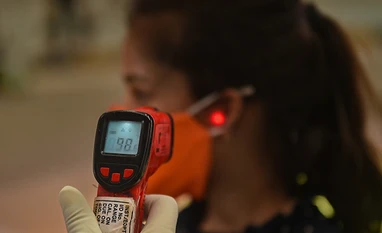
A medic conducts thermal screening of a passenger waiting to board a train to Delhi at Howrah station, during the ongoing Covid-19 nationwide lockdown, in Kolkata. Photo: PTI
5 min read Last Updated : May 26 2020 | 2:21 PM IST
Here is a round-up of important articles from across Indian publications on Covid-19. From reopening schools and rescheduling exams, to India and China’s role in vaccine development, and why reverse migration may have set the country back by 15 years — read these and more in today’s India dispatch.
Expert Speak
It’s not a problem if schools are the last to open: When online teaching modules may not be viable for many institutes, when most state governments are struggling to reach a consensus on the when-what-how of reopening schools and rescheduling exams, an average student, teacher or parent is staring at many complex questions. Read this interview with educationist Rukmini Banerji, the chief executive officer of Pratham Education Foundation, to find some answers.
Why was the lockdown extended beyond April 15? Since the novel coronavirus pandemic came to India, Dr T Jacob John, a celebrated virologist and former professor at the Christian Medical College, Vellore, has been a vocal advocate of more public health surveillance, smarter use of diagnostic tests, and transparency in government decision-making. Read this interview with him on these issues and more.
Reverse migration to villages has set economy back by 15 years, says JNU professor: This interview with Santosh K Mehrotra, professor of economics at the Centre for Informal Sector & Labour Studies at Jawaharlal Nehru University, and author of the recently launched book Reviving Jobs: An Agenda For Growth explains how the current reverse migration has set the country back by 15 years. Mehrotra stresses that the economic stimulus package announced by the government is minuscule compared to the package rolled out by the Manmohan Singh government of the time during the 2008 crisis. Read it here
Long Reads
Any attempt to develop a Covid-19 vaccine can’t afford to overlook India and China’s role: Whether it is hydroxychloroquine, the “miracle” drug Donald Trump has admitted to taking, or remdesivir, an antiviral drug used as an emergency treatment for the most acute cases of Covid-19, or a future vaccine, the physical as well as social and economic health of the world depends on pharmaceuticals. Production from China and India will be crucial if the pandemic is to be brought under control. Read more here
Opinion
Lack of education, erosion of science fuelling paranoia constructed around Covid-19: There is a subtle difference between caution and fear when it comes to containing a pandemic of this scale. Caution helps in salvaging the self while fear consumes both the self and those around us. Stigmatisation comes from fear. If we want to come out of the ruins of this pandemic and from the consequences of the lockdown, we have to remove fear and stigma from this awful disease. Read more here
India cannot expect to beat coronavirus without tackling systemic hate and deep-rooted corruption: This is an opportunity to end communal bias and other discrimination in governance and restore the impartiality of state institutions. To effectively handle the pandemic, it is vital for Parliament, the media, civil society, constitutional authorities, and courts to hold the government to account over its failings, particularly when they infringe on people’s rights. Read more here
Managing Covid-19
Mumbai runs out of hospital beds as Covid-19 cases continue to rise: For years, India’s booming private hospitals have taken some of the strain off the country’s underfunded and dilapidated public health network, but as coronavirus cases explode in India, even private facilities are at risk of being overrun. More than a fifth of the country’s coronavirus cases are in Mumbai, India’s financial hub and its most populous city. Read more here
60 districts, 10 cities — how ICMR is going deep into India’s heart to chart Covid course: Sixty districts and 10 cities. Twenty-one states. Over 24,000 subjects. The Indian Council of Medical Research (ICMR) is conducting a large-scale exercise to assess Covid-19 exposure across the country. Armed with serological tests — blood tests that look for antibodies to diagnose exposure to a microorganism, in this case, the novel coronavirus — teams across India are trying to gauge the incidence of Covid-19. Read more here
Kerala cops arrest agents who tried to charge migrant workers Rs 7,500 to return home: In a desperate bid to return home amid the lockdown, migrant workers in Kerala have been using up their life savings to arrange transportation facilities on their own, to return home. On Monday, hundreds of such migrant workers in Kerala’s Pathanamthitta district took to the streets after they were denied permission to book a bus and travel to their hometowns. The workers had tried to book buses from a travel operator in the region to travel back home. Read more here
Understanding Covid-19
Strokes in Covid-19 patients — Four studies capture trends: How frequent, and how severe, are strokes among Covid-19 patients? A series of papers in the journal Stroke, published by the American Heart Association, examines trends from four countries. The broad findings: The rate of strokes in Covid-19 patients appears relatively low; but — a higher proportion of those strokes are among younger people. Read more here