India looks at drones to power its armed forces

Country gears up for era of soldier-less battlefields despite gaps in policies on use of drones
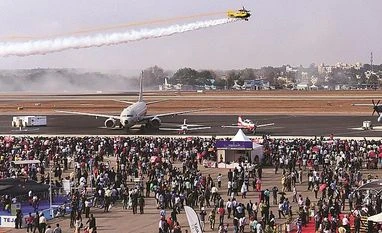
Skycat Wingwalkers from the Scandinavian Airshow aerobatic team on the fourth day of the 11th biennial edition of Aero India 2017 at the Yelahanka air base in Bengaluru on Friday 	Photo: PTI
Skycat Wingwalkers from the Scandinavian Airshow aerobatic team on the fourth day of the 11th biennial edition of Aero India 2017 at the Yelahanka air base in Bengaluru on Friday Photo: PTI
Alnoor Peermohamed Bengaluru
Last Updated : Feb 18 2017 | 1:24 AM IST
India is investing heavily in developing unmanned vehicles — ground, sea and air — as it gears up for a fast-approaching era of soldier-less battlefields despite the current void in policies governing how they will be used.

Government-run labs of the DRDO (Defence Research and Development Organisation) and National Aeronautics Ltd, along with state-owned defence manufacturer Hindustan Aeronautics Ltd, are working on several drone projects, right from vehicles that weigh under a kg to Rustom II, which will have a payload capacity of 350 kg.

The DRDO, which designed the Tejas light combat aircraft and drones such as Nishant and Lakshya, is putting together a policy document for the year 2020 as well as a more advanced one for 2025, which has laid emphasis on building the country’s drone capabilities. But being a nascent technology, it is also looking at the country’s premier research institutes for talent and new technology.

“We have good capability in terms of software and, with Make in India, several foreign companies are coming in, because of which production capabilities are bound to get developed. Why can’t we put the two together and create UAVs for the air, ground and underwater?” said S Christopher, chairman of the DRDO, at a conference last week. The DRDO is also working on a series of unmanned vehicles including unmanned combat aircraft, or UCAV, which will be powered by the homegrown Kaveri engine. Similarly, HAL, which is a risk-sharing partner in the development of Rustom II along with the DRDO, is working with the Indian Institute of Technology, Kanpur, for the development of a 10-kg mini-rotary drone. With flight tests conducted successfully, HAL now plans to scale up the same technology for 50-kg, 200-kg and 500-kg rotary drones, said T Suvarna Raju, chairman of HAL, at the Aero India event. The plethora of global manufacturers displaying UAVs at Aero India this year signalled the interest of India’s armed forces to procure these machines. Israel Aerospace Industries, Elbit, Saab, Boeing and many other smaller players gave a prominent display of their drones, some of which were capable of weaponised warfare. JK Organisation Friday announced its foray into India’s drone market in partnership with Canadian firm MicroPilot. There are commercial sectors that will benefit from this.

Unlike Rustom II, with a wingspan of 20-odd metres, the market for mini-UAVs is huge. However, the market is being held back by the lack of policy governing how drones can be used, but which should likely be addressed by an upcoming drone policy.

“The demand for mini-UAVs is currently Rs 2,000 crore, but this is really constrained by a lack of clarity on the regulations, which is expected to go away in the next few months. Once that’s behind us, we expect the market to grow by at least three times in the next three years,” said Rajesh Kakkar, chief executive, Global Strategic Technologies Ltd, JK Organisation.

JK’s Deepti Electronics & Electro Optics Pvt Ltd (DELOPT) unit, which currently builds payloads such as cameras for small drones, has partnered Canadian firm MicroPilot to supply the autopilot system for these UAVs. With this, DELOPT hopes to become an even larger supplier of drone ancillaries to the armed forces, paramilitary or police, which are looking to deploy drone platforms built by other manufacturers.

Kakkar says the market for drones in India could grow by three times in the next three years once the government gives the industry more clarity. For the defence sector, India’s ever-growing need for new fighter aircraft like the LCA and Sukhoi 30 MKI could potentially be offset by the use of UAVs.

One subscription. Two world-class reads.

Already subscribed? Log in

Subscribe to read the full story →
*Subscribe to Business Standard digital and get complimentary access to The New York Times

Smart Quarterly

₹900

3 Months

₹300/Month

SAVE 25%

Smart Essential

₹2,700

1 Year

₹225/Month

SAVE 46%
*Complimentary New York Times access for the 2nd year will be given after 12 months

Super Saver

₹3,900

2 Years

₹162/Month

Subscribe

Renews automatically, cancel anytime

Here’s what’s included in our digital subscription plans

Exclusive premium stories online

  • Over 30 premium stories daily, handpicked by our editors

Complimentary Access to The New York Times

  • News, Games, Cooking, Audio, Wirecutter & The Athletic

Business Standard Epaper

  • Digital replica of our daily newspaper — with options to read, save, and share

Curated Newsletters

  • Insights on markets, finance, politics, tech, and more delivered to your inbox

Market Analysis & Investment Insights

  • In-depth market analysis & insights with access to The Smart Investor

Archives

  • Repository of articles and publications dating back to 1997

Ad-free Reading

  • Uninterrupted reading experience with no advertisements

Seamless Access Across All Devices

  • Access Business Standard across devices — mobile, tablet, or PC, via web or app

Next Story



