Isro to launch IRNSS-1C on October 16
Series of IRNSS will put India's own navigation system on par with US' GPS
T E Narasimhan Chennai The launch of IRNSS IC, the third of seven satellites in the series to put in place India's navigation system on a par with US' Global Positioning System or the Russian Glonass, that was deferred following a technical snag has now been rescheduled for October 16.
The Indian Space Research Organisation (ISRO) today said that the Polar Satellite Launch Vehicle (PSLV)-C26 will carry the navigation satellite IRNSS 1C whose original launch date of October 10 was changed to October 16.
The IRNSS-1C is the third of the seven in the series of satellites to put in place India’s own navigation system on a par with US’ GPS or the Glonass from the spaceport of Sriharikota.
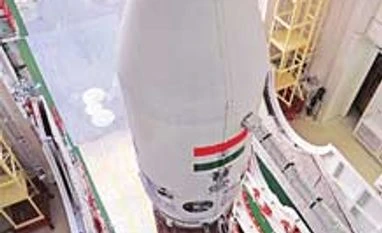
ISRO's workhorse PSLV-C26 will lift off at 1.32 am on October 16 from the First Launch Pad of Satish Dhawan Space Centre (SDSC) SHAR, Sriharikota, about 100 kms from Chennai. The vehicle will carry 1,425 kg IRNSS-1C, the third satellite in the series.
The satellite has already been integrated with the vehicle and the final phase of the check is progressing. The Mission Readiness Review Committee and the Launch Authorization Board met on October 7, 2014 to review the progress of the pre-launch activities and cleared the launch for October 16, said ISRO. The 67-hour count down for the mission will commence at 6.32 am on October 13, 2014.
PSLV-C26 and will use 'XL' version of PSLV and this is the seventh time the XL configuration is being flown, the last one being the PSLV-C25 used for the Mars Orbiter Mission.
IRNSS is an independent regional navigation satellite system being developed by India.
It is designed to provide accurate position information service to users in India as well as the region extending up to 1,500 km from its boundary, said ISRO.
IRNSS-1C is the third of the seven navigation satellites constituting the IRNSS space segment. Its predecessors, IRNSS-1A and IRNSS-1B were laun- ched by PSLV-C22 and PSLV-C24 in July 2013 and April 2014 respectively.
IRNSS-1C has a lift-off mass of 1,425.4 kg. The configuration of IRNSS-1C is similar to that of the IRNSS-1A and IRNSS-1B.
The satellite has been realised in less than six months after the launch of its predecessor.
IRNSS-1C will carry two types of payloads -- the navigation payload and ranging payload. The navigation payload of IRNSS-1C will transmit navigation service signals to the users.
This payload will operate in L5 band (1176.45 MHz) and S band (2492.028 MHz). A highly accurate rubidium atomic clock is part of the navigation payload of the satellite. The ranging payload of IRNSS-1C consists of a C-band transponder which facilitates accurate determination of the range of the satellite. IRNSS-1C also carries the Corner Cube Retro Reflectors for laser ranging, said ISRO.

 "Isro to launch IRNSS-1C on October 16")


 Connect with us on WhatsApp