Home / India News / JLF Day 2: Of rosogollas, revolutionary poetry and the republic of ideas
JLF Day 2: Of rosogollas, revolutionary poetry and the republic of ideas
Much of the discussion on Padmaavat dwelt on how Indian constitutional values were being upheld or abandoned in the reaction to the movie
premium
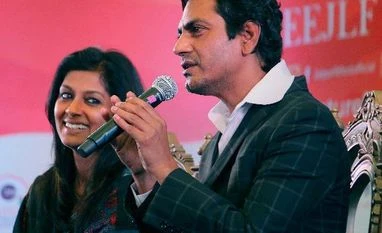
Bollywood actor Nawazuddin Siddiqui and film director Nandita Das at a session during Jaipur Literature Festival 2018 at Diggi Palace in Jaipur (Photo: PTI)
On Republic Day, the Jaipur Literature Festival grappled, in its own inimitable way, with the past and future of the Indian republic. The day featured ex-heads of state and Bollywood stars, as well as economists, ex-diplomats, historians and novelists. There were sessions on revolutionary poetry -- Vishal Bhardwaj talking about Hamlet and Haider -- as well as on universities, Swachh Bharat, the murdered journalist Gauri Lankesh, China and India, and Mahatma Gandhi with the renowned Gandhi scholar Tridivesh Suhrud. There was also a session which featured five Bengalis talking about rosogollas.
Of course, Padmaavat continued to be part of the conversation, with much of the discussion turning on how Indian constitutional values were being upheld or abandoned in the reaction to the movie. Vishal Bhardwaj argued that protest against the movie -- against any movie -- was perfectly justified; but pointedly asked why non-violent protest was not considered enough. In the last session of the day -- devoted to free speech, and titled 'Republic of Rhetoric' -- the moderator, Salil Tripathi, argued that a film that had gone through the process of certification and been cleared by the courts could hardly then be prevented by the government from being shown. In response, Additional Solicitor General Pinky Anand argued that while the film-makers and the courts were acting in consonance with their rights, state governments also had the legal right to ban creative works that they believed would disturb law and order. This was not a popular view with the audience, which grilled Anand about whether the ban was politically motivated and whether or not political parties would always err on the side of excessive bans.
The origins of the Indian republic's attitudes were also explored. In the free speech session, Abhinav Chandrachud, a lawyer and writer, pointed out that laws in India had never been too friendly to speech right from Nehru's era. Earlier in the day, there was a session on Dr Ambedkar and his legacy -- which, of course, includes the Constitution. The thorny question of reservations was inevitably raised: Bengali writer Manoranjan Byapari, who famously was pulling a rickshaw in what was then Calcutta when he met Mahasweta Devi, questioned whether poorer Dalits had benefited from reservations at all. Even the session with Bollywood glamour looked back to Partition: Vinod Dua talked to Nandita Das and Nawazuddin Siddiqui about the life and legacy of the Punjabi writer Manto.
Perhaps the best-attended session of the day -- for which the front lawns were packed well over capacity, just before lunch -- titled 'Dreamers: Looking at Young India' and featured the poets Akhil Katyal and Gaurav Solanki; the writers Prayaag Akbar, Prashant Jha, Snigdha Poonam and Hansda Sowvendra Shekhar; and the college student-turned-reluctant activist Gurmehar Kaur. Much of the discussion centred around what 'nationalism' meant for younger Indians. In punchy Hindi, Solanki argued that what millions of young Indians wanted was jobs, and that a narrative focused on nationalism could not replace that need -- and got the biggest applause of the day. Kaur, the youngest panelist of the festival, got the most questions from an audience overwhelmingly in their teens or early twenties.
A later session on 'The End of Work', which dealt with the threats and possibilities of automation and artificial intelligence, also brought into sharp relief the insecurities of young people dealing with an uncertain job market. Much of the discussion, and the questions from the younger audience members that followed, focused on how the education system was failing younger people. Once again, a sharp division of opinion on the question of the desirability of a Universal Basic Income or UBI was visible -- as well as on whether Indian entrepreneurship could solve the problems caused by a lack of jobs. The million young people entering the job market every month were repeatedly mentioned.
A good proportion of that million seemed to be milling around the premises of Diggi Palace on Friday, taking advantage of the Republic Day holiday to attend the festival. The crowds strained the venue's capacity -- and were a clear reflection of a divided society hungry for opinion and information, clapping and applauding alternative points of view. Saturday and Sunday are expected to see even longer queues to get in.

 "JLF Day 2: Of rosogollas, revolutionary poetry and the republic of ideas")











