Lalu: Down and out, or merely down?

With Yadav-Muslim vote bank intact and sympathy on side, it may not be all over for Lalu just yet
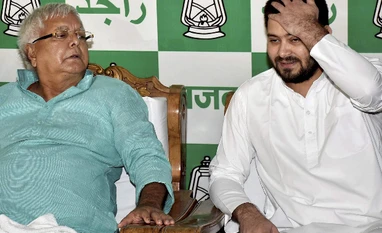
Lalu Prasad Yadav, Tejashwi Yadav
Lalu Prasad with son Tejaswi during a press conference earlier this week; (below) Bihar Chief Minister Nitish Kumar and his deputy, Sushil Kumar Modi, at their swearing-in ceremony
Satyavrat MishraAditi Phadnis
Last Updated : Jul 29 2017 | 10:05 PM IST
As in cricket, so also in politics, every thing is possible. On the afternoon of July 26, Rashtriya Janata Dal (RJD) supremo Lalu Prasad conveyed a meeting of his legislators to formulate a strategy to counter the Bharatiya Janata Party’s (BJP) vociferous demand for the resignation or dismissal of his son, Tejaswi Yadav, the then deputy chief minister, over graft charges.

The Janata Dal (United) had issued a gag order against its excessively voluble spokesmen on Tuesday (July 25), giving hints that Chief Minister Nitish Kumar was softening his stand. “Nitish never asked for the resignation or even any clarification from Tejaswi. It is all a media creation. Nitish Kumar is the leader of the Grand Alliance and there is no danger to our government. The maha gathbandhan is unbreakable,” declared Lalu triumphantly after the meeting.

Less than four hours later, Nitish submitted his resignation citing irrevocable differences among the alliance members, particularly between the RJD and the JD (U). “Over the last 20 months, I ran the government to the best of my abilities, but in the current atmosphere it was not possible for me continue further,” Nitish told newsmen after submitting his resignation. “I followed coalition dharma at every step. I never asked for anyone’s resignation but I expected them to at least give an explanation to the people of Bihar.

It’s one thing to dub it (the corruption case) as politically motivated, but there is also a public perception. They neither listened to me nor took any action. I supported action against owners of benami properties. How can I back off from my principles? I listened to my antaratma, my inner voice, and decided to resign.”

The maha gathbandhan, which was formed exactly three years ago in 2014 and termed as unbreakable, was now in tatters. The Lalu-Nitish jodi — which had once beaten the unbeatable Narendra Modi and the BJP — was broken in a matter of just 20 days. 

Less than 15 hours later, Nitish was back on the job, this time with the BJP by his side. Lalu and the Congress are still stunned. “The match was fixed. I had an indication about it. I treated him as my younger brother and let him be the CM, but he turned out to be a huge opportunist. Hum Shankar bhagwan ki tarah boley ki jao raj karo, yeh to Bhasmasur nikala,” Lalu told reporters on Thursday (July 27).

Congress Vice-president Rahul Gandhi also claimed that the “planning” was going on for three-four months and he “knew about it”. However, this point also proves the RJD and the Congress leadership was easily outsmarted by Nitish.

“We knew something fishy was going on between Nitish and (Sushil Kumar) Modi. With the Governor’s arrival and all the BJP MLAs being ordered to remain in Patna, we had a hint that something important was going to happen in the next few days,” says a senior RJD leader. “That’s why Laluji even cancelled his visit to Ranchi where he was to appear before a CBI court. However, we had no clue that Nitish would resign; it was completely out of the blue.” Several leaders, particularly those who held ministerial berths in the erstwhile Grand Alliance government, are still shocked.

Why shouldn’t they be? RJD, which was out of power in Bihar since 2005, had returned to the treasury benches after a decade, as a part of the Grand Alliance — comprising the RJD, the JD (U) and the Congress — and won almost three-fourth of the seats in the high-pitched Bihar Assembly election in 2015. In less than two years, RJD MLAs once again find themselves in the opposition benches.

However, many leaders, even those with JD (U), are sympathetic towards the RJD chief saying that Nitish abandoned Lalu when Lalu needed his allies the most. “I’m not saying that Lalu is a saint. His constant interference in the transfer of mid-level officers was unbearable. The charges of benami transaction against Tejaswi became an albatross around our neck. But right now he is under attack from all sides,” says a senior JD (U) leader. “The CBI, the Enforcement Directorate and every other federal investigative agency is now targeting him. Fighting cases is a costly affair and, therefore, he desperately wanted to be in power.”

Cost-benefit analysis

It cannot be denied that Nitish has not emerged unscathed from this bloodless coup. Among the Muslims and Yadavs, the traditional vote bank of Lalu, Nitish has lost significant support. The JD (U) has six Muslim and 11 Yadav MLAs. Officially, the party is not worried about any defection. But unofficially, the party is keeping a close watch on them.

Conversely, this is the silver lining for the RJD in this fiasco. Lalu was able to keep most of the Yadav-Muslim vote bank intact and his supporters are totally behind the Yadavs, despite the graft charges. The incident has also helped the rise of Tejaswi as the natural successor to his father. 
“The charges are all fabricated. Most important, they are against Laluji. Why was Nitish targeting Tejaswi? He is a good boy and he respects his elders, says Kabul Khan, a resident of Rohtas district. “We voted Nitish into power to stop the BJP. He cheated us. Laluji should never have trusted him in the first place. He should have projected Tejaswi.” Khan travelled seven hours to come to Patna and stood for at least five hours outside Lalu’s house to get a glimpse of his leader.
“We have got our chief ministerial candidate. His name is Tejaswi Prasad Yadav,” says RJD MLA Shakti Singh Yadav.

The divorce settlement

So, speaking realistically, who has lost and who has gained from the entire episode?
Lalu and his RJD may have lost their place in the government. But there is sneaking sympathy for the father-son duo. For one, their exclusion from the government has wiped off the incumbency taint.

Second, the combined blessings of the Muslim and the Yadav vote are not inconsiderable. Consider what the Centre of Study of Developing Societies (CSDS) said after the result of the 2015 Assembly elections when Nitish and Lalu joined hands to sweep the election: while the National Democratic Alliance (NDA) managed to largely retain its vote base among the lower OBCs and Kurmi-Koeris, its vote share among Dalits and Yadavs declined significantly.

Nitish Kumar with senior BJP leader Sushil Modi at an oath taking ceremony, at Raj Bhawan in Patna.

 
Moreover, as Rahul Gupta and Pranav Gupta’s co-authored article tells us, there was, and continues to be, an uneasy fit between the core support bases of the RJD and the JD (U), namely the Yadavs and the Kurmis, respectively. A study by the two authors states that Nitish’s separation from Lalu’s RJD, which led to the formation of the Samata Party and then the JD(U), has its roots in the Kurmi Chetna Rally of 1994, at Patna’s Gandhi Maidan. The major issue at the rally was of the Yadavs getting all the benefits, while the Kurmis were marginalised in the Lalu regime.

According to the study, this mutual distrust was also reflected in opinion poll surveys conducted by Lokniti-Centre for the Study of Developing Societies in 2014. The results clearly showed that while RJD voters and the Yadavs were not very fond of Nitish, the JD (U) voters and the Kurmis had a similar perception about Lalu.
So you could argue that there was a sense of inevitability about the divorce.

For instance, in a CSDS survey conducted in January 2014, voters were asked about Lalu’s arrest in the fodder scam case and whether the sentence handed down was appropriate or rather harsh. One in every five JD (U) voter said the punishment should have been more stringent.

But now that Nitish has a new partner, will the new partner saffronise him? Or will Nitish’s influence be a tempering force on the loud and increasingly vocal vigilante groups? And how will Lalu leverage this equation to his advantage?

What will follow will be another deeply interesting chapter in Bihar politics.

One subscription. Two world-class reads.

Already subscribed? Log in

Subscribe to read the full story →
*Subscribe to Business Standard digital and get complimentary access to The New York Times

Smart Quarterly

₹900

3 Months

₹300/Month

SAVE 25%

Smart Essential

₹2,700

1 Year

₹225/Month

SAVE 46%
*Complimentary New York Times access for the 2nd year will be given after 12 months

Super Saver

₹3,900

2 Years

₹162/Month

Subscribe

Renews automatically, cancel anytime

Here’s what’s included in our digital subscription plans

Exclusive premium stories online

  • Over 30 premium stories daily, handpicked by our editors

Complimentary Access to The New York Times

  • News, Games, Cooking, Audio, Wirecutter & The Athletic

Business Standard Epaper

  • Digital replica of our daily newspaper — with options to read, save, and share

Curated Newsletters

  • Insights on markets, finance, politics, tech, and more delivered to your inbox

Market Analysis & Investment Insights

  • In-depth market analysis & insights with access to The Smart Investor

Archives

  • Repository of articles and publications dating back to 1997

Ad-free Reading

  • Uninterrupted reading experience with no advertisements

Seamless Access Across All Devices

  • Access Business Standard across devices — mobile, tablet, or PC, via web or app

Next Story



