Meet Omkar Hota, who carried a pregnant woman to hospital on cot for 12 km

For many, Hota's journey with the patient is proof of how an individual can make a difference when the system fails
omkar hota
Omkar Hota
Dillip Satapathy
Last Updated : Nov 10 2017 | 10:02 PM IST
In remote, inaccessible parts of Odisha, it is not uncommon to see patients being carried to hospitals on cots for miles. Every now and then, this image is used to draw attention to the poor condition of healthcare in the state. 

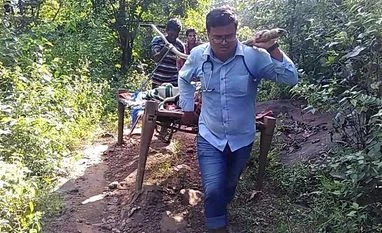
But recently, this picture was reversed, when a doctor trekked 12 km to attend to a pregnant tribal woman in a far-flung village. The woman’s condition was grim, and the doctor, Omkar Hota, realised she needed to be taken to hospital. There was only one way of doing so — by ferrying the patient on a cot. Through the trek back, Hota lent his shoulder to the makeshift stretcher. The woman made it to the hospital in time, and both she and her newborn survived.

For many, Hota’s journey with the patient is proof of how an individual can make a difference when the system fails. 

Hota, 33, works at the Papulur public health centre in the Chitrakonda block of Malkangiri district on the southern tip of Odisha. He has been posted here for the last seven months. Though this health centre has existed for 15 years, 24 hours is the longest any doctor has spent here. Most refuse to work here. Located on a hilly terrain, 90 km from the district headquarters, the area has little communication or power facilities. And then, it is infested with mosquitoes and Naxals.

“When I came here, I found that very few patients would come to the hospital,” Hota says. When they fell ill, the locals, who belong to the Konda Reddy and Bonda tribes, turned to traditional medicine. Soon after he joined, he started visiting the villages, interacting with people, treating them and convincing them to come to the hospital if they fell ill. 

This is not the first time Hota has trekked the mountain roads carrying a patient to the health centre. He has done it several times in the past. “This incident (which a local resident recorded on his mobile phone) has gone viral and drawn a lot of attention,” he says. 

“It is a 24-hour job for me,” says Hota. Every evening, after winding up his day in the hospital, he goes to the villages carrying medicines for common ailments. He treats the patients, distributes the medicines and tries to create awareness about maintaining hygiene and the use of mosquito net to prevent malaria.

The villagers look upon Hota as their messiah. “The initial distrust is gone. People now welcome me into their villages as one of their own,” he says. Even the Naxals, whom he has encountered on a few occasions in the night on the way back from his village visits, request him to carry on with the good work.

Today, on an average, 45 patients visit the health centre every day as opposed to the 10-odd who would make the effort before Hota took over. Cases of malaria too are down to seven a month from around 90 about six months back.

After doing his MBBS from a private medical college in Bhubaneswar, Hota opted to join the government service. After his last transfer from a hospital in Bolangir, he asked to be posted in a tribal area where no doctor was willing to go.

It’s a decision he had made as a Class X student while visiting a hospital in Bolangir with his mother. “There, I found the doctors fleecing the poor,” he says. “My mother made me pledge that I would become a doctor and would serve the poor.”

In the absence of official quarters, Hota, who is a bachelor, lives in one of the rooms at the hospital. 

His efforts have not gone unnoticed. Odisha Chief Minister Naveen Patnaik has felicitated him and the district administration has conferred him with the best medical service award. “Such recognition motivates you, but I know mine is a profession of sacrifice,” he says.  

He hopes to specialise in cardiology, and “then return to a tribal area and serve the poor”. 

One subscription. Two world-class reads.

Already subscribed? Log in

Subscribe to read the full story →
*Subscribe to Business Standard digital and get complimentary access to The New York Times

Smart Quarterly

₹900

3 Months

₹300/Month

SAVE 25%

Smart Essential

₹2,700

1 Year

₹225/Month

SAVE 46%
*Complimentary New York Times access for the 2nd year will be given after 12 months

Super Saver

₹3,900

2 Years

₹162/Month

Subscribe

Renews automatically, cancel anytime

Here’s what’s included in our digital subscription plans

Exclusive premium stories online

  • Over 30 premium stories daily, handpicked by our editors

Complimentary Access to The New York Times

  • News, Games, Cooking, Audio, Wirecutter & The Athletic

Business Standard Epaper

  • Digital replica of our daily newspaper — with options to read, save, and share

Curated Newsletters

  • Insights on markets, finance, politics, tech, and more delivered to your inbox

Market Analysis & Investment Insights

  • In-depth market analysis & insights with access to The Smart Investor

Archives

  • Repository of articles and publications dating back to 1997

Ad-free Reading

  • Uninterrupted reading experience with no advertisements

Seamless Access Across All Devices

  • Access Business Standard across devices — mobile, tablet, or PC, via web or app

Next Story



