The February 13 meeting between Nancy Powell, who quit as US ambassador to India on Monday, and Narendra Modi, the Bharatiya Janata Party (BJP)’s prime ministerial candidate, was frosty enough to convince the Roosevelt House (the official address of the US Embassy in New Delhi) and the White House in Washington DC that much had to be done before US diplomats could aspire to any significant access to a Modi-led government in India.
The embassy has been somewhat rattled since the meeting, the first since the US denied Modi a visa to visit that country in 2005.
Sources in South Block say the Chinese and Japanese embassies might have better rapport with a Modi-headed Prime Minister’s Office, compared to the embassies of the US, the UK, France and Germany.
At the February 13 meeting, which lasted an hour and a quarter, Modi and Powell discussed diplomatic and trade relations. Neither Modi nor Powell brought up the visa issue. Sources privy to the meeting said Modi conveyed to Powell his unhappiness at the manner in which the US had handled the Devyani Khobragade case.
The talks were held without the help of an interpreter, in a mix of Hindi and English. While Modi primarily spoke in Hindi with a smattering of English, Powell spoke in halting Hindi, preferring English for complex issues. To assist the two, a senior bureaucrat sat within earshot.
Sources said in what had brought cheer to Indian diplomats, Modi had reportedly castigated the Americans over the Khobragade issue. “Our information is the Americans returned from the meeting somewhat rattled,” said a source.
Modi told Powell Khobragade was treated shabbily and hoped Powell would empathise with Khobragade, as she, too, was a diplomat, sources said. “Our assessment is the Roosevelt House took this as veiled warning that American diplomats shouldn’t expect any special treatment from a Modi-led government, something the it was quite accustomed to from the UPA (United Progressive Alliance) before the Khobragade controversy,” said a source. Bureaucrats close to Modi told the visiting American delegation the Gujarat chief minister had no desire to visit the US. “The Americans cannot stop him from visiting the UN in New York during the General Assembly. Beyond that, the CM has little fascination for visiting the US,” said a source.
What had galled those close to Modi, bureaucrats and influential American-Indians alike, was all these years, the Roosevelt House had let UPA ministers influence its decisions on a visa to Modi and on whether the Americans should engage with him or not.
“We have reasons to believe key UPA ministers and a couple of senior bureaucrats convinced the Americans not to engage with Modi,” said a source in the BJP.
Both South Block and BJP sources said it was unlikely Modi’s ascendance to the prime ministerial chair would affect the bigger picture of India-US relations. “But what might change is the ease of doing business that American diplomats were used to in the UPA dispensation,” said a source. This is what the US will try address by bringing in new faces at Roosevelt House, possibly from the influential Gujarati community in America.
After Modi became Gujarat’s chief minister for the third consecutive time in 2012, the US delayed its outreach to Modi, while many other western nations didn’t. Then British High Commissioner James Bevan called on Modi in October 2012, a couple of months before the Gujarat Assembly elections. At that meeting, Modi had said, “Der aaye durust aaye (better late than never).” In January 2013, a month after his Assembly election victory, German Ambassador Michael Steiner had hosted a lunch for Modi on behalf of all European Union countries.
The Russian ambassador to India had publicly lauded Modi’s victory in the 2012 Gujarat Assembly elections.
Modi shares particularly good relations with the Chinese, his website says. As Gujarat chief minister, he has visited that country thrice, the last time in November 2011, when he was hosted at the Great Hall of the People. “The reason is simple. The Chinese admire strong leaders. They find it easier to do business with leaders who can deliver on their promises,” says a source close to Modi.
Modi has also visited Japan, South Korea and other east Asian countries. The Israeli embassy has also maintained regular contact with Modi. Sources close to Modi say under him, the Gujarat administration has had friendly relations with business communities from most of India’s neighbours, particularly Pakistan. They add business delegations from Karachi, the capital of Punjab’s Sindh province, have visited Gujarat often.
In July 2012, Bangladesh High Commissioner Tariq A Karim had met Modi in Gandhinagar.

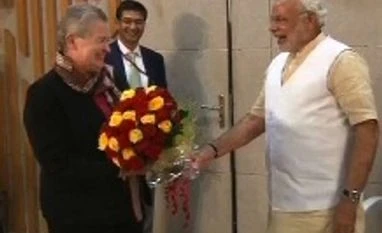 "Modi-Powell meet sealed US envoy's future in India")


 Connect with us on WhatsApp