
Modi-Trudeau meeting: Hugplomacy fails to hide angst over Khalistan
Modi minces no words, says India won't tolerate threats to its sovereignty
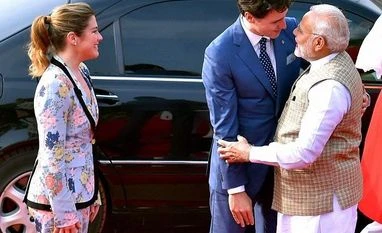 "Modi-Trudeau meeting: Hugplomacy fails to hide angst over Khalistan")
premium
WebinarsNew
Deep DiveNew
Explore Business Standard
Modi minces no words, says India won't tolerate threats to its sovereignty
However, the orchestrated bonhomie of hugs between Trudeau and Modi, and pictures the Canadian PM, his wife and three children, couldn't hide the frostiness between the two sides because of Trudeau and his party's support to Khalistani groups in Canada.
In his speech at the joint media conference after the delegation level talks, Modi didn't mince words about the pro-Khalistan approach of his Canadian counterpart.
Modi said those challenging India's sovereignty, unity and integrity cannot be tolerated. The PM said there cannot be any place for those who misuse religion for political motives and promote separatism.
India and Canada signed agreements to deepen cooperation in higher education, information, communication technology and electronics, intellectual property rights, renewable energy, sports and science and technology. Modi said Trudeau and he agreed to deepen defence cooperation.
Apart from issuing the customary joint statement, the two sides also signed a framework for cooperation on counter terrorism and violent extremism.
The framework said the two countries would work together to neutralize, among other groups, threats from Babbar Khalsa International and International Sikh Youth Federation. The framework stated that it is based on fundamental respect for the sovereignty, unity and territorial integrity of India and Canada.
The joint statement recognized the "importance of civil society groups as a mainstay of democratic societies." The two sides resolved to "intensify" negotiations to finalise a Comprehensive Economic Partnership Agreement (CEPA) and a Bilateral Foreign Investment Promotion and Protection Agreement (FIPPA).
It said India and Canada will work closely together to finalise an arrangement within 2018 to enable the export of Canadian pulses to India. Modi and Trudeau agreed to expand the scope of the Canada-India Ministerial Energy Dialogue to additionally include electricity, energy efficiency and renewables, and also welcomed the cooperation in civil nuclear energy sector.
India and Canada also agreed to expand security cooperation through the institutionalisation of NSA (National Security Adviser)-level dialogues and regular convening of Foreign Minister-level strategic dialogues.
Modi and Trudeau also expressed "strong concern" about recent developments in Maldives and their implications for a free society. They urged the Maldivian government to ensure early resumption of the political process after revoking the state of emergency.
Earlier in the day, External Affairs Minister Sushma Swaraj met the Canadian PM.
Already subscribed? Log in
Subscribe to read the full story →

3 Months
₹300/Month
1 Year
₹225/Month
2 Years
₹162/Month
Renews automatically, cancel anytime

Over 30 premium stories daily, handpicked by our editors


News, Games, Cooking, Audio, Wirecutter & The Athletic
Digital replica of our daily newspaper — with options to read, save, and share


Insights on markets, finance, politics, tech, and more delivered to your inbox
In-depth market analysis & insights with access to The Smart Investor


Repository of articles and publications dating back to 1997
Uninterrupted reading experience with no advertisements


Access Business Standard across devices — mobile, tablet, or PC, via web or app
First Published: Feb 23 2018 | 6:11 PM IST


