
Mumbaikars to get additional 118 km of metro corridors
Infra experts say govt will first need to figure out how to exploit real estate along the proposed routes
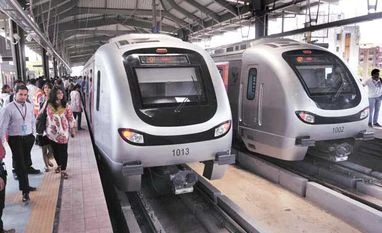 "Mumbaikars to get additional 118 km of metro corridors")
WebinarsNew
Deep DiveNew
Explore Business Standard
Infra experts say govt will first need to figure out how to exploit real estate along the proposed routes
The state-run Mumbai Metropolitan Region Development Authority (MMRDA) has sanctioned 118 km of metro network which envisages a total investment of Rs 35,400 crore.
According to infrastructure experts, the government will have to address issues concerning fares, right of way and commercial exploitation of real estate along the proposed routes before MMRDA kick-starts implementation of the proposed metro corridors to ensure viability.
The decision comes despite the MMRDA's dispute with Reliance Infra arm Mumbai Metro One Pvt Ltd (MMOPL) with regard to the fare of 11.4-km Versova-Andheri-Ghatkopar corridor.
The development of 118-km Metro network includes 40-km Dahisar-Charkop-Bandra-Mankhurd Metro-2 corridor (Rs 12,000 crore), 40-km Wadala-Ghatkopar-Thane-Kasarvadavali Metro-4 corridor via Wadala GPO and RAKidwai Marg (Rs 12,000 crore), 27-km Dahisar-E-Andheri-E-Bandra-E Metro-5 corridor (Rs 8,100 crore) and 11-km Jogeshwari-Vikhroli Link Road Metro-6 corridor (Rs 3,300 crore).
A government official told Business Standard: ''The government and the MMRDA hope an early resolution of issues pertaining to the 11.4-km metro corridor. Metro is a viable option in the Mumbai city and therefore the 118 km of network has been cleared. These corridors will be now developed on cash-contract basis wherein proposed metro corridors will be totally funded by MMRDA."
However, PwC Partner & Leader (infrastructure) Manish Agarwal, said Metro projects would not be feasible on fare box revenues. The model of up to 40% capital grant will also not be sufficient. According to Agarwal, "Institutional integration will be a key success factor, enabling land use and Metro planning integration, transport integration and operational and technology integration.
"Pricing of urban transport is a complex issue. The interplay of time saved, convenience and cost is different from different demographic classes. The Urban Transport Pricing Policy (UTPP) including for parking needs to thought of in an integrated manner and the Metro pricing needs to then be a part of it. That different agencies manage different parts of this, makes it difficult to optimise."
Further, MMRDA's former commissioner Rahul Asthana suggested that the fare box revenues should be such that they cover the cost of servicing the loan over its tenure. If the state entities realise that return on their investment will be negligible and accept this in view of the public good, then fares could be kept at reasonable levels.
"As for keeping the fares reasonable, the government must treat its equity as an investment with negligible returns and pay off loans through fare box collections. Real Estate development should be restricted as very high Floor Space Index to operators degrades areas where it is granted," Asthana said.
First Published: Aug 27 2015 | 4:40 PM IST


 Connect with us on WhatsApp