
What makes 'Namaste' the perfect greeting in the times of Covid-19 pandemic
As people the world over are choosing to ditch the handshakes and hugs for fear of contracting the coronavirus, namaste is becoming the perfect pandemic greeting
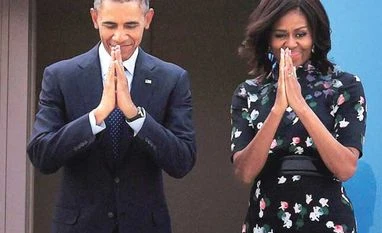 "What makes 'Namaste' the perfect greeting in the times of Covid-19 pandemic")
premium
WebinarsNew
Deep DiveNew
Explore Business Standard
As people the world over are choosing to ditch the handshakes and hugs for fear of contracting the coronavirus, namaste is becoming the perfect pandemic greeting
As people the world over are choosing to ditch the handshakes and hugs for fear of contracting the coronavirus, namaste is becoming the perfect pandemic greeting.
As a scholar whose research focuses on the ethics of communication and as a yoga teacher, I’m interested in how people use rituals and rhetoric to affirm their interconnectedness with one another – and with the world.
Namaste is one such ritual.
As people the world over are choosing to ditch the handshakes and hugs for fear of contracting the coronavirus, namaste is becoming the perfect pandemic greeting So namaste means “I bow to you.” This meaning is often reinforced by a small bow of the head.
In Hindi and a number of other languages derived from Sanskrit, namaste is basically a respectful way of saying hello and also goodbye. Today, namaste has been adopted into the English language, along with other words from non-English sources. Many words, when borrowed, keep their spelling but acquire new meanings. This is the case with namaste – it has shifted from meaning “I bow to you” to “I bow to the divine in you.”
For many American yoga teachers, beginning most likely with Ram Dass in the 1960s and 1970s, namaste means something like “the divine light in me bows to the divine light within you.” This is the definition of namaste I first learned and have often repeated to my students.
In the words of the popular American yoga teacher Shiva Rea, namaste is “the consummate Indian greeting,” a “sacred hello,” that means “I bow to the divinity within you from the divinity within me.”
Deepak Chopra repeats a similar definition on his podcast “The Daily Breath with Deepak Chopra”: namaste means “the spirit in me honors the spirit in you” and “the divine in me honors the divine in you.”
Namaste has a sacred connotation. When you bow to another, you are honoring something sacred in them. When you bow to another, you are acknowledging that they are worthy of respect and dignity.
However, there are critics who say that global yogis have taken namaste out of its context. Some claim that the greeting has been infused with a religious meaning that doesn’t exist in Indian culture.
I see things differently. Many common salutations have religious roots, including adios, or “a Dios,” to God, and goodbye – a contraction of “God be with you.”
Most Indian religions agree that there is something divine in all individuals, whether it’s a soul, called the “atman” or “purusha” in Hinduism, or the capacity for awakening in Buddhism.
As I argue in my forthcoming book, “The Ethics of Oneness: Emerson, Whitman, and the Bhagavad Gita,” this idea, of bowing to the divine in others, also resonates with a deep spiritual inclination in American culture.
Beginning in the 1830s and 1840s, the influential philosopher and essayist Ralph Waldo Emerson, in dialogue with a number of other thinkers, invented a form of spiritual practice that encouraged Americans to actively address the divine soul in others every time they spoke.
Of particular note is that Emerson often used the metaphor of light to imagine this inner divinity, likely because of his great admiration for the Quakers, whose Christian denomination holds that God lives inside of us all in the form of an “inner light.”
The definition of namaste as “the divine light in me bows to the divine light in you” is very much in the spirit of both Indian religions and 19th-century traditions of American spirituality.
In today’s global yoga culture, namaste is typically said at the end of class. As I understand, for yogis, saying namaste is a moment of contemplating the virtues associated with yoga – including peacefulness, compassion, and gratitude and how to bring those into one’s daily life.
I asked Swami Tattwamayananda, the head of the Vedanta Society of Northern California in San Francisco and one of the world’s leading authorities on Hindu ritual and scripture, how he felt about Americans like me saying namaste.
He responded: “It is perfectly appropriate for everyone, including Westerners like yourself to say namaste at the end of your yoga classes.” He also reiterated that namaste means “I bow down to you” – in the sense that I bow down to the divine presence in you.
[Deep knowledge, daily. Sign up for The Conversation’s newsletter.]
One need not be a Hindu, or a Buddhist, or a yoga teacher to say namaste. Namaste can be as religious or secular as the speaker desires.
What matters most, I believe, is the intention behind the word namaste. When you bow to another, the question to consider is this: Do you truly recognise them as a fellow human being worthy of dignity, bonded in shared suffering and a shared capacity for transcendence?
This recognition of our interconnectedness is what namaste is all about – and exactly what we need during the pandemic.
Jeremy David Engels, Professor of Communication Arts and Sciences, Pennsylvania State University
This article is republished from The Conversation under a Creative Commons license. Read the original article.
Already subscribed? Log in
Subscribe to read the full story →

3 Months
₹300/Month
1 Year
₹225/Month
2 Years
₹162/Month
Renews automatically, cancel anytime

Premium stories handpicked daily by our editors


News, Games, Cooking, Audio, Wirecutter & The Athletic
Digital replica of our daily newspaper — with options to read, save, and share


Insights on markets, finance, politics, tech, and more delivered to your inbox
In-depth market analysis & insights with access to The Smart Investor


Repository of articles and publications dating back to 1997
Uninterrupted reading experience with no advertisements


Access Business Standard across devices — mobile, tablet, or PC, via web or app
First Published: Oct 01 2020 | 8:51 AM IST


 Connect with us on WhatsApp