No major gains in higher education under NDA govt, reveals AISHE report

Criticism levelled against govt is that it failed to allocate more funds to education sector in past three years
higher education
Sahil Makkar New Delhi
Last Updated : Jan 06 2018 | 2:32 AM IST
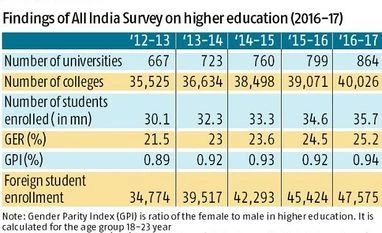
The All-India Survey on Higher Education (AISHE) for the year 2016-17, released on Friday, revealed the rates of growth of universities and colleges, and the number of students enrolled in the first three years of the National Democratic Alliance (NDA) government have been lower than in the last year (2013-14) of the previous United Progressive Alliance (UPA) government.

The number of universities in India was 723 in 2013-14, 760 in 2014-15, 799 in 2015-16 and 864 in 2016-17. The rates of growth of universities in 2013-14, 2014-15, 2015-16 and 2016-17 were 8.4 per cent, 5.1 per cent, 5.1 per cent and 8.1 per cent, respectively.

The number of students in higher education institutes in the country was 32.3 million in 2013-14, 33.3 million in 2014-15, 34.6 million in 2015-16 and 35.7 million in 2016-17. The rates of growth in the number of colleges for 2013-14, 2014-15, 2015-16 and 2016-17 are estimated to be 7.3 per cent, 3.1 per cent, 3.9 per cent and 3.2 per cent, respectively.

Source: MHRD
The gross enrollment ratio (GER) — the ratio of the number of students enrolled for higher education to the total population in the 18-23 age bracket, considered a major indicator of a country’s progress in higher education — has not shown a significant increase in the past three years as well. The GER for 2016-17 was 25.2 per cent, a slight increase from 24.5 per cent in 2015-16. In 2014-15 and 2013-14 it was 23.6 per cent and 23 per cent, respectively.

“Our aim is to increase the GER to 30 by 2020,” Union Minister for Human Resource Development Prakash Javadekar said while launching the AISHE report. “Our government is committed to quality, autonomy, innovation and research. We will soon be announcing measures to provide more autonomy to those colleges and universities which have been given A-plus rating by the National Assessment and Accreditation Council (NAAC),” he said.

The NDA government has undertaken various measures in higher education, including passing of the IIM Bill, setting up an agency for the funding of higher education institutes, national ranking of the top performing institutes, and announcing the setting up of 20 centres of excellence. However, all such measures have mostly benefitted established and premier institutes such as the Indian Institutes of Technology (IITs), Indian Institutes of Management (IIMs), National Institutes of Technology (NITs) and Indian Institute of Science (IISc).

A criticism levelled against the government is that it has failed to allocate more funds to the education sector in the past three years. The NDA government’s expenditure on education in 2014-15, 2015-16 and 2016-17 was 2.8 per cent, 3.1 per cent and 3.2 per cent, respectively, of the gross domestic product (GDP). It is almost on a par with what the UPA spent on education. The Centre’s expenditure on education in 2011-12 and 2012-13 and 2013-14 was 3.2 per cent, 3.1 per cent and 3.1 per cent, respectively, of the GDP.

The AISHE report further revealed that there was no major change in the Gender Parity Index (GPI), a ratio of the number of females to males enrolled in higher education institutes. The GPI for 2016-17 was 0.94 per cent, a slight increase from 0.92 per cent in the previous year. “We are making efforts to increase the number of female students in both the IITs and NITs,” the minister said.

Javadekar also urged teachers to provide their Aadhaar numbers. The government is for the first time counting the number of teachers in higher education by using their Aadhaar details. “We have found 70,000-80,000 teachers teaching in three or four institutions. We have data on 85 per cent of teachers and request the rest to provide their,” he added. 

One subscription. Two world-class reads.

Already subscribed? Log in

Subscribe to read the full story →
*Subscribe to Business Standard digital and get complimentary access to The New York Times

Smart Quarterly

₹900

3 Months

₹300/Month

SAVE 25%

Smart Essential

₹2,700

1 Year

₹225/Month

SAVE 46%
*Complimentary New York Times access for the 2nd year will be given after 12 months

Super Saver

₹3,900

2 Years

₹162/Month

Subscribe

Renews automatically, cancel anytime

Here’s what’s included in our digital subscription plans

Exclusive premium stories online

  • Over 30 premium stories daily, handpicked by our editors

Complimentary Access to The New York Times

  • News, Games, Cooking, Audio, Wirecutter & The Athletic

Business Standard Epaper

  • Digital replica of our daily newspaper — with options to read, save, and share

Curated Newsletters

  • Insights on markets, finance, politics, tech, and more delivered to your inbox

Market Analysis & Investment Insights

  • In-depth market analysis & insights with access to The Smart Investor

Archives

  • Repository of articles and publications dating back to 1997

Ad-free Reading

  • Uninterrupted reading experience with no advertisements

Seamless Access Across All Devices

  • Access Business Standard across devices — mobile, tablet, or PC, via web or app

Next Story



