PM Modi's all-party meet on J&K: No big expectations, say experts

"It is a sequel to the democratic process of elections already on in the region and should be seen as just that: nothing more, nothing less," say top government sources
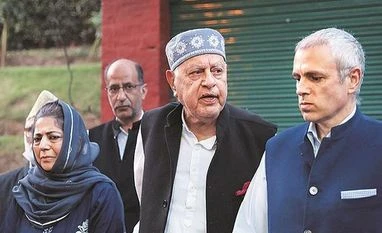
Farooq Abdullah, Omar, mehbooba mufti, article 370, j&k
The eight-phase DDC election was the first direct election in J&K since the writing down of Article 370
Aditi Phadnis New Delhi
3 min read Last Updated : Jun 23 2021 | 11:58 PM IST
The all-party meet to be hosted by Prime Minister Narendra Modi on Thursday will be the first exploratory outreach by the Centre to political parties in Jammu and Kashmir (J&K). However, it is unlikely to discuss anything as dramatic as statehood or a schedule for assembly elections.

“It is a sequel to the democratic process of elections already on in the region and should be seen as just that: nothing more, nothing less,” say top government sources.

Two tiers of local body elections – for Panchayats and District Development Councils (DDCs) – have already been held. The eight-phase DDC election was the first direct election in J&K since the writing down of Article 370. It was also the first election in which the two bitter rivals – the Farooq Abdullah-headed National Conference (NC) and People’s Democratic Party (PDP) led by Mehbooba Mufti – which had banded together as the People’s Alliance for Gupkar Declaration (PAGD), contested. The turnout of voters in both the Muslim-majority Kashmir valley and the Hindu-majority Jammu was higher than in the panchayat election, indicating that people wanted the election process to re-start.

The panchayat elections were boycotted by the PDP. The party may have felt this was a tactical mistake as PDP members contested as representatives of other parties. Such was the pent-up demand to contest.

In the DDC elections, against 64.21-72.71 per cent turnout during different phases in the Jammu region, Kashmir recorded 29.91-40.65 per cent turnout. But the turnout was better than earlier elections. For instance, Srinagar district, which registered a turnout of 35.3 per cent in the DDC elections, had registered only 7.90 per cent and 14.5 per cent turnout in the parliamentary and panchayat elections, respectively.

Building on the momentum of these exercises, the PM has called PAGD and other J&K leaders for a broad-based discussion on what to do next.

“J&K is a hive of vested interests,” says a government source. “There are separatist groups whose very existence depends on making sure no common space emerges between democratic forces and the Union government. And, there are covert agencies that thrive in an atmosphere where democratic forces are absent. The interests of both the groups converge in ensuring normalcy, even partial, never returns,” say sources. According to them, one way of derailing talks is to raise the expectations bar so high that the outcome is deemed unsatisfactory.

The government is realistic – issues of statehood can only be thrashed out in Parliament. Assembly elections are still some distance away. But the bitterness of political leaders, who have emerged after a long period of detention, has to be given a vent. The Prime Minister will be in listening mode tomorrow (Thursday), say sources. “Nothing radical should be expected from the meeting” they add.

The backstory of the meeting is that when Farooq Abdullah fell ill with Covid-19, state lieutenant governor Manoj Sinha called on him. In the course of that meeting, he also met Omar Abdullah. Something in the mien of the two leaders compelled him to flag the issue to the PM, who agreed to have a broad-based meeting.

There is another aspect of the meeting. With several western countries, including the US, hammering India on its limited democracy, the government is keen to show that a conversation with democratic forces is underway.

One subscription. Two world-class reads.

Already subscribed? Log in

Subscribe to read the full story →
*Subscribe to Business Standard digital and get complimentary access to The New York Times

Smart Quarterly

₹900

3 Months

₹300/Month

SAVE 25%

Smart Essential

₹2,700

1 Year

₹225/Month

SAVE 46%
*Complimentary New York Times access for the 2nd year will be given after 12 months

Super Saver

₹3,900

2 Years

₹162/Month

Subscribe

Renews automatically, cancel anytime

Here’s what’s included in our digital subscription plans

Exclusive premium stories online

  • Over 30 premium stories daily, handpicked by our editors

Complimentary Access to The New York Times

  • News, Games, Cooking, Audio, Wirecutter & The Athletic

Business Standard Epaper

  • Digital replica of our daily newspaper — with options to read, save, and share

Curated Newsletters

  • Insights on markets, finance, politics, tech, and more delivered to your inbox

Market Analysis & Investment Insights

  • In-depth market analysis & insights with access to The Smart Investor

Archives

  • Repository of articles and publications dating back to 1997

Ad-free Reading

  • Uninterrupted reading experience with no advertisements

Seamless Access Across All Devices

  • Access Business Standard across devices — mobile, tablet, or PC, via web or app

Topics :Jammu and Kashmir politicsNarendra ModiFarooq AbdullahOmar AbdullahMehbooba MuftiJammu and KashmirBharatiya Janata Partycentral government

Next Story



