PM Modi's classroom: Bureaucrats told to change work ethics and mindsets

The occasion was Civil Services Day and the PM's 'classroom' comprised senior IAS officers in Delhi
Modi
Modi
Archis Mohan New Delhi
Last Updated : Apr 22 2017 | 7:59 AM IST

Don't want to miss the best from Business Standard?

With the Narendra Modi government expecting better delivery of its schemes and programmes on the ground as the 2019 Lok Sabha elections draw nearer, Prime Minister (PM) Narendra Modi on Friday asked senior Indian Administrative Service (IAS) officers of the country, including district magistrates of 599 of the 706 districts, to change their work ethic and mindsets.

The occasion was Civil Services Day and the PM’s ‘classroom’ comprised senior IAS officers in Delhi and district magistrates of 599 of the country’s 706 districts. 

The speech via videoconferencing also reached district-level officials across the country. 

The PM’s over an hour long speech was motivational in parts, but it was primarily a stinging critique of the manner in which the bureaucracy has functioned since Independence. He also seemed to be demanding from the bureaucracy quicker decisions.

Modi said it was time the bureaucracy moved from its role as a regulator to becoming an enabler. Modi said bureaucrats need not be afraid of any consequences for taking quick decisions as he would stand by them if the decision was taken with honest intent and with the public interest in mind. 

“Something momentary may happen but I am with you,” the Prime Minister said. The PM’s comment is significant, given several bureaucrats have referred to three Cs — the Comptroller and Auditor General (CAG), the Central Bureau of Investigation and the Central Vigilance Commission — as stumbling blocks in decision-making, ultimately resulting in policy paralysis.

The PM asked civil servants to weigh their decisions from an outcome point of view and not merely tabulate output. “Do statistics lead to any change?” he asked. He said: “Output is okay for the CAG. If we see CAG-centric output, then there won’t be any change in the country.”

“We will neither be able to see any change, nor would any change come in the country. But if we see things from ‘CAG+1’ then there would be changes,” he said.

Modi spared neither the older bureaucrats, nor the younger lot. He criticised the bureaucracy’s colonial inheritance of hierarchy and said the “experience” of senior bureaucrats tended to become a “burden” for the entire system as they tried to stall efforts at improvement lest the juniors might outshine them. 

The PM also advised younger bureaucrats to learn from their seniors the importance of anonymity in doing their work. He said they should use social media to spread awareness, increase the participation of people in government schemes, and not use it to circulate their photographs at events. “I, for one, have banned the use of mobile phones during my meetings,” Modi said.

It was for the second successive day that bureaucrats found themselves chided.

On the first day of the event on Thursday, Home Minister Rajnath Singh had advised bureaucrats to take decisions with a big heart, not petty mindedness, and to be part of the solution, not the problem.

Both the PM and Home Minister’s advice to the bureaucracy comes on the heels of Uttar Pradesh Chief Minister Yogi Adityanath questioning the need for so many holidays in his state, and speculation in the bureaucratic circles in New Delhi that the Modi government might bring back the six-day week. In Friday’s speech, the PM appealed them to exhibit excellence in their work, introspect where they might have gone wrong, to break their silos and work as a team to perform, and to transform the country for it be one of the advanced nations of the world by 2022. 

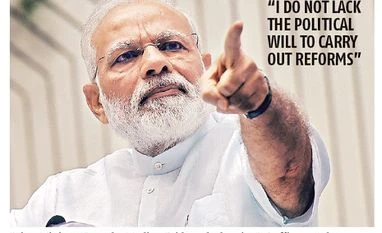
Modi said political will can reform, but bureaucracy performs and public participation transforms. “We have to bring them on one wavelength and when we run these three (political will, performance by bureaucracy and public participation) on one wavelength, then we get good results,” he said. As for political will, Modi said: “I do not lack it and may be having a bit extra.”

He said hierarchy in the bureaucracy remains an issue which has been inherited from colonial rulers and “was not left behind in Mussoorie (where the civil service academy is located)”. Talking about people’s perception towards bureaucracy, he said when bureaucrats are not bad and they are not out to work with some bad will, then what is the reason that common man instead of having a “bhaav” (feeling), has “abhaav” (complaint)? “What is the reason? We must introspect and if we do that, then I don’t feel we need big changes (in changing people’s perception),” Modi said.

He said people clap when the Army saves lives during flood in Kashmir. 

Additional inputs from PTI


One subscription. Two world-class reads.

Already subscribed? Log in

Subscribe to read the full story →
*Subscribe to Business Standard digital and get complimentary access to The New York Times

Smart Quarterly

₹900

3 Months

₹300/Month

SAVE 25%

Smart Essential

₹2,700

1 Year

₹225/Month

SAVE 46%
*Complimentary New York Times access for the 2nd year will be given after 12 months

Super Saver

₹3,900

2 Years

₹162/Month

Subscribe

Renews automatically, cancel anytime

Here’s what’s included in our digital subscription plans

Exclusive premium stories online

  • Over 30 premium stories daily, handpicked by our editors

Complimentary Access to The New York Times

  • News, Games, Cooking, Audio, Wirecutter & The Athletic

Business Standard Epaper

  • Digital replica of our daily newspaper — with options to read, save, and share

Curated Newsletters

  • Insights on markets, finance, politics, tech, and more delivered to your inbox

Market Analysis & Investment Insights

  • In-depth market analysis & insights with access to The Smart Investor

Archives

  • Repository of articles and publications dating back to 1997

Ad-free Reading

  • Uninterrupted reading experience with no advertisements

Seamless Access Across All Devices

  • Access Business Standard across devices — mobile, tablet, or PC, via web or app

Next Story



