Rahul visits Ayodhya, skips Ram temple
He is the first one from Nehru-Gandhi family to visit the town in 26 years
Amit Agnihotri New Delhi Rahul Gandhi created a buzz on Friday when he visited a temple in Ayodhya in Uttar Pradesh as part of a Brahmin-centric approach to woo the electorate ahead of the Assembly polls next year. He visited the Hanuman Garhi temple in Ayodhya as part of his kisan yatra from Deoria in eastern UP to Delhi.
The Congress vice-president, however, skipped the controversial Ram temple nearby. The visit was significant as a Nehru-Gandhi family member had visited the town after a gap of 26 years.
In 1990, former prime minister Rajiv Gandhi had visited Ayodhya but could not pray at the Hanuman Garhi temple. He was assassinated the next year.
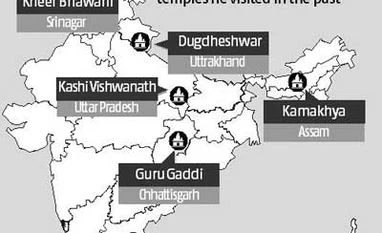
On September 6, when Rahul Gandhi started his foot march, he offered prayers at the Dugdheshwar Mandir in Rudrapur. Earlier, he had visited the Tirupati temple in 2009, Kamakhya temple in Guwahati and the Kashi Vishwanath temple in 2014. In 2016, he worshipped at the Guru Gaddi temple in Girodhpuri, Chhattisgarh. In Srinagar, he offered prayers at the Kheer Bhawani temple.
Last month, Sonia Gandhi was scheduled to visit the well-known Kashi Vishwanath temple in Varanasi, but could not as she had to cut short her roadshow due to ill health. Later, she vowed to return to the ancient city and pray at the Kashi Vishwanath temple.
In 2001, Sonia Gandhi had surprised her foes by taking a dip in the holy Ganges at the Kumbh Mela, the mega congregation of Hindus at Allahabad.
In the past, the Congress had been accused by the Bharatiya Janata Party (BJP) of pursuing a soft-Hindutva line, but party leaders said such visits should not been seen with a religious prism.
"This is a matter of faith for an individual, but the BJP does politics over it," Congress lawmaker from Deoria Akhilesh Singh told Business Standard.
Sources, however, said temple hopping by Sonia and Rahul are part of the Congress' UP poll campaign, as the grand old party is eyeing to win over the crucial 10 per cent Brahmin voters who had drifted away from the party over the past two decades.
Although the Brahmins voted for the BJP in the 2014 national elections, large sections of the upper caste community are miffed with the saffron party and are looking for a new political anchor.
Sensing this opportunity, strategist Prashant Kishor suggested to Rahul Gandhi that the Congress should pitch itself as the party the Brahmins could look up to. Declaring three-term Delhi chief minister Sheila Dikshit as the Congress' chief ministerial nominee in UP was part of the plan.
Dikshit is the daughter-in-law of UP Congress veteran Uma Shankar Dikshit and represented Lok Sabha from Brahmin-majority Kannauj in 1985. Along with the Brahmins, the Congress is also eyeing to win back the Muslims and Dalits who had been its traditional vote banks.
After the 1992 demolition of the Babri mosque in Ayodhya, the Congress lost these communities to the Bahujan Samaj Party (BSP) and the Samajwadi Party (SP).
While BSP chief Mayawati emerged as the champion of Dalits, SP president Mulayam Singh Yadav wooed the Yadavs and Muslims. Although the Brahmins sided with the BSP in 2007, the community deserted party chief Mayawati in 2012.

 "Rahul visits Ayodhya, skips Ram temple")


 Connect with us on WhatsApp