Home / India News / Rewind 2018: India's targets on climate change, Katowice & Paris Agreement
Rewind 2018: India's targets on climate change, Katowice & Paris Agreement
t took collective pressure from all developing countries, including India, to ensure the rulebook adheres to the letter of the agreement even if it did not stay entirely loyal to its spirit
premium
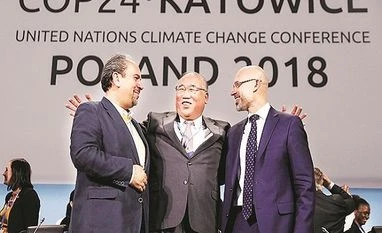
China’s head of delegation Xie Zhenhua is flanked by the head of Iranian delegation Majid Shafiepour Motlagh (left) and COP24 President Michal Kurtyka at the summit in Katowice
India finalised a report noting that it was well on the way to meeting two of its three targets under the first phase of the Paris Agreement. Soon after, the Katowice climate change negotiations ended with a rulebook to the Paris Agreement. It took collective pressure from all developing countries, including India, to ensure the rulebook adheres to the letter of the agreement even if it did not stay entirely loyal to its spirit.
For instance, the rules eroded the difference between developing and developed countries to a layer deeper than the agreement had rendered. With the Paris Agreement itself pared down to let countries largely self-determine how much heft they should put behind the collective fight against climate change, the rules were not expected to deliver more. But Katowice did deliver a set of rules that will monitor countries deeply for their delivery against the nationally-determined actions, particularly on reducing greenhouse gas emissions.
Countries could not, however, agree to the rules for the operation of the global market for trading in greenhouse gas emissions under the Paris Agreement. Developed countries wanted developing countries not to take credit for the emissions they trade in. Developing countries wanted the rich nations not to get to harvest the low-hanging cheaper emission reduction targets only to their account, leaving the poorer nations with heavy bills for technology in emission reductions.
The rules for the market mechanism were deferred to 2019, or perhaps 2020, just before the Paris Agreement gets implemented, starting 2021. Next year will also witness a summit organised by the UN Secretary General, who has put his weight behind pushing countries to enhance their targets even before the agreement kicks off.
Read this article for free
Register to continue reading premium journalism and analysis from Business Standard.

 "Rewind 2018: India's targets on climate change, Katowice & Paris Agreement")










 Connect with us on WhatsApp