THE BRAHMAPUTRA, one of the most sediment-laden rivers in the world, is home to a geographical phenomenon--a unique network of an estimated 2,300-plus islands that result from the vast quantities of sand, silt and rock that the river carries along its course, down from the mountains and onto the plain.
The silt and sand accumulate along its flow to form temporary islands. The rocks that tumble along in its course, and the sediment the river carries, give these islands body. Most of these islands are impermanent--literally shifting sands, except for a few very large ones. The biggest of them, Majuli, is the world's largest river island. Even after it has shrunk to a third of its original size, thanks to erosion, it is still vast, spreading over 400 sq km--nearly as large as the capital of Rajasthan, Jaipur. Once you are there, you do not realise that you are on an island in the midst of a mighty river.
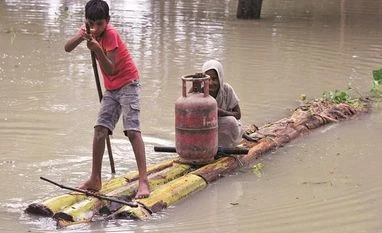
When the floods come, people fend for themselves in relief camps, or in temporary shelters along the embankments criss-crossing the flood plains, and even on boats. Once the floods recede, they return to find, at times, that 'their' home island has shifted downstream, sometimes as much as a few kilometres, and that they have to start all over again. This process is cyclical; sometimes they have to go through this process a few times every year, depending on the number of floods and their ferocity. Stress is a constant companion.
These islands are home to nearly a tenth of Assam's population of 35 million, and to a diverse range of communities, including some who live in a national park. Also resident on these chars are many species of wildlife including elephant herds, wild buffalo and feral horses as well as migratory and local birds, while the endangered river dolphins are occasionally sighted in the river and its tributaries.
This space is a universe apart. Buffaloes wallow or swim in the shallows; a fisherman steers his dugout towards our boat and offers us a glowing golden carp--his catch of the day, a whopping one-and-a-half kilos, for Rs 800; an unfinished wooden bridge, with pillars but no top, stands stark against the skyline, silent and accusing. A country boat sputters a careful course through the spaces between the large pillars.
ON KOBU sapori in Dhemaji district--one of the better known and older islands on the river--a small group of men from different communities gathers in the local primary school to speak with their visitors.
It has taken us over an hour and a half to get here from the nearest ferry point--which is really nothing more than the bank where boats anchor to take on passengers and goods. The one we hire is a noisy country boat about 20 metres long, with an engine that splutters indignantly when it is turned on, sinks into an occasional coma, and as suddenly comes to life--not the most reassuring form of transport to traverse even a small tributary of the mighty, moody Brahmaputra. But there is very limited choice of transport, and this is what we get.
Sharma is an unofficial spokesperson for this disparate group of farmers and teachers, all of them with the weather-beaten faces and hardy constitutions of those who live along and on the river, with its myriad uncertainties.
Precise or not, Sharma's numbers tell a story of Assam's saporis. It is not about the precarious existence of those who live on the shifting sands but of the many who, unable to cope with the stress of losing homes and land and livestock, are leaving in search of jobs elsewhere.
This jells with our observations. Earlier, as we prepared to board the wooden, rough-hewn country boat that brought us to Kobu, we noticed that an entire family has travelled over on the incoming trip. They're moving, with the tin sheets of their dismantled roofs, the wooden beams, their cooking utensils, gas cylinder, and a trunk-load of clothes. It is a visible sign of the exodus that is all too common along this stretch of the river.
"With active participation from respective state governments, there has been mass return of migrants to their native places," wrote R. Lusome and R. B. Bhagat in 'Migration in Northeast India: Inflows, Outflows and Reverse Flows during Pandemic'. "Migrants from the Northeast are not an exception. More than 138 Shramik Special trains transported nearly 188,000 stranded people to various states of the northeast."
This is not counting those who arranged their own transportation. In all, the study estimates based on newspaper reports, "the number of migrants returning to the northeast during the period of the lockdown is estimated at 512,000. This constitutes about half of the out-migration from the northeast in 2011. This mass return migration to the northeast was unprecedented. About 390,000 migrants returned to Assam alone--a state beleaguered due to immigration politics."
The reasons for out-migration are many: the uncertainty of life along the saporis, the diminishing returns from farms and from fishing, the constant stresses attendant on recurring floods that wipe out the fruits of their labour, the uncertain safety and security situation, the lack of adequate educational facilities, marriage, etc., Lusome and Bhagat say in their study.
What we know is that this out-migration is ongoing; and that those who leave rarely return, except for short visits to the families they have left behind, or during seasonal holidays such as Dussehra, Puja, Bihu, Christmas and New Year, when in any case employment opportunities are limited.
The story of Kobu is repeated elsewhere. In Lakhimpur, Dhemaji, Tinsukia and Dibrugarh, people are leaving their homes of decades, driven away by the eroding power of the rivers. Some move to government-allotted lands, but this is not always a satisfactory solution--one group, for instance, was given land in a hilly area far from the river, where they could neither farm nor fish and thus found themselves without the means to earn a living. Others sell their land for whatever price they can get, and move to the mainland.
We have reached out to officials for comment on the land allotted for those whose homes are destroyed by the river, and will update the story when we receive a response.
On our way back from Kobu, we get stuck in the shallows. Twice. Each time, the burly boatman--who nurses the engine along and navigates with his rudder--jumps out to push the boat out of the shallows and back into navigable waters. Helping him is a pilot, who is supposed to know the river, its depths and its current surges, like we know the roads of our native city. He uses a long bamboo pole with a dual purpose: it helps to steer the boat, and is also a tool to plumb the depths and detect the silent shallows lying below the surface. This particular pilot isn't very savvy with the river, and repeatedly gets yelled at by the 'captain' of the little boat.
One of my companions regales us with the story of how, on an earlier trip, he and his team had got delayed getting to a landing point. It was dark, he said, before their vehicle finally headed out of the forest--and then they saw their path blocked by a herd of elephants which started moving towards them. He reversed the vehicle slowly, he told us, for about 500 metres with the elephants still ambling forward; finally, he found another motorable path, and dashed away.
Now there are fewer sightings of elephants, he says--and while I am a little relieved at the lessened risk, I'm also concerned about what the thinning of elephant herds portends.

 "River Reflections: Impermanence, erosion, migration on the Brahmaputra")










 Connect with us on WhatsApp