Women of India turned red with fury when Prayar Gopalakrishnan, chief of Sabarimala temple said that he would only allow female worshippers into the shrine, which is dedicated to Lord Ayyappa, when there is a machine invented to detect whether or not women had their periods.
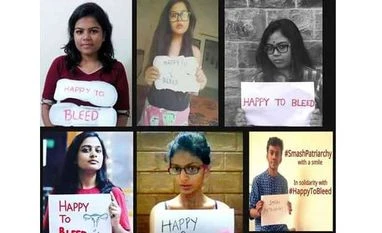
His comments outraged women which led to a campaign that did not take time to make headlines. The ‘Happy To Bleed campaign’ started by Nikita Azad on November 21 garnered massive support and gained prominence on Facebook and Twitter.
The issue has resurfaced as Supreme Court of India came down heaving on the Sabarimala Trust, saying that in Hindu religion there is no denomination of a Hindu male or female and a 'Hindu is a Hindu'.
The SC had earlier asserted that it would decide on the right of women to enter the historic Sabarimala shrine on the basis of constitutional principles and not by the prevalent customary practices.
'Happy To Bleed' campaign. Photo: Facebook
Menstruation a taboo
It is not just about Sabarimala temple but in India many temples debar entry of women because they are considered impure during their periods. Notices are slapped at the entry gates of temples to keep women away. And it doesn’t end at this; women in rural India are not allowed to touch idols of gods and goddesses, they are even asked to stay in a separate room.
Raising voice against sexism
A 20 year old Nikita Azad was agitated when she first heard that women were not allowed to enter Sabarimala temple because they are not pure. According to BBC, Azad, with a few of her friends, started a week-long online campaign on Facebook titled ‘Happy To Bleed’.
In an interview Azad said, “Happy To Bleed is a counter campaign launched against menstrual taboos, and sexism that women are subject to through it. It acknowledges menstruation as a natural activity which doesn’t need curtains to hide behind.”
The campaign which received massive support of women asked them 'to hold placards/sanitary napkins/charts saying 'Happy To Bleed' and post the pictures on their profiles or the campaign page 'to oppose the shame game played by patriarchal society since ages'.
Women took to Twitter to offer their support to the campaign. A woman had tweeted, “Don’t forget its [sic] the same ‘Impurity’ you survived on, for nine months inside your mother’s womb. #HappyToBleed.”
In a Facebook post, Japleen Pasricha, founder of Feminism in India, put it like so: “My vagina bleeds which is ironically why you accept me as a ‘woman,’ else I’d have been dismissed as barren. So shut the fuck up about impurity, this blood is the reason why you’re alive.”
Story behind the entry ban
The Sabarimala temple website explains that the temple was one of four Ayyappa temples which constitute the worship of the Dharmashasta deity. Only the Sabarimala temple barred women’s entry because it symbolised Ayyappa’s Brahmachari stage. Sabarimala temple authorities too maintained that the temple’s denial of entry for women had nothing to with menstruation-related ‘impurity’, but said that certain rules had to be observed for the presiding deity who was celibate.
Now, it is for the the apex court in India to decide whether or not menstruation is a fundamental right.

 "Sabarimala temple row: No doors are shut for women")


 Connect with us on WhatsApp