SC judges and the ghost of Emergency: The other shameful chapter

Considered one of the most shameful chapters in the history of the apex court
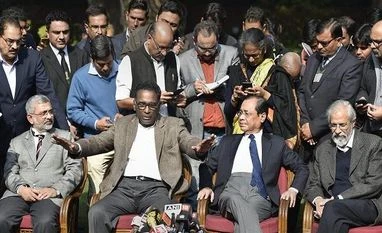
Supreme Court judge Justice Chelameswar along Justice Ranjan Gogoi, Madan Lokur and Kurian Joseph during a press conference in New Delhi on Friday. Photo: PTI
Archis Mohan New Delhi
Last Updated : Jan 12 2018 | 2:33 PM IST
The 'ADM, Jabalpur vs Shivakant Shukla’ judgement, better known as the Habeas Corpus case, delivered by a five-judge bench of the Supreme Court at the height of the Indira Gandhi government imposed Emergency, in 1976, is considered one of the most shameful chapters in the history of the apex court.

It would seem from the statements of the four Supreme Court judges, who raised the banner of revolt on Friday afternoon against the manner in which Chief Justice of India Dipak Mishra is assigning cases, at least they do not want posterity to remember them in the same breath as four of the five judges on the bench who on April 28, 1976, given the ‘Additional District Magistrate versus Shivakant Shukla’.

In that case, a division bench of Chief Justice AN Ray, and Justices MH Beg, YV Chandrachud, PN Bhagwati and HR Khanna had set aside nine High Court judgements, including ‘ADM Jabalpur versus Shivakant Shukla’, that had ruled in favour of enforcement of fundamental rights during the Emergency. Only Justice Khanna had dissented.

Their judgement had upheld the constitutionality of the draconian 'Maintenance of Internal Security Act', or MISA, under which thousands of political activists had been arrested across India during the Emergency. It had declared that the right to habeas corpus also does not stand during the Emergency. Justice Khanna was the seniormost judge after Chief Justice Ray, but was superseded by the Indira Gandhi government. In 1999, the Atal Bihari Vajpayee government had conferred on him the Padma Vibhushan.

On Friday afternoon, Justice J Chelameshwar said at the press conference: “We don’t want wise men saying 20 years from now that Justices Chelameswar, (Ranjan) Gogoi, (Madan Bhimrao) Lokur and Kurian Joseph sold their souls.” He also suggested if things continued the way they have democracy in India would be in peril.

Clearly, the ghost of ‘ADM Jabalpur vs Shivakant Shukla case’ continues to haunt at least some of the current Supreme Court judges, just as Justice Hans Raj Khanna continues to inspire them. Incidentally, Justice Gogoi is the next in line to be the Chief Justice of India.

One subscription. Two world-class reads.

Already subscribed? Log in

Subscribe to read the full story →
*Subscribe to Business Standard digital and get complimentary access to The New York Times

Smart Quarterly

₹900

3 Months

₹300/Month

SAVE 25%

Smart Essential

₹2,700

1 Year

₹225/Month

SAVE 46%
*Complimentary New York Times access for the 2nd year will be given after 12 months

Super Saver

₹3,900

2 Years

₹162/Month

Subscribe

Renews automatically, cancel anytime

Here’s what’s included in our digital subscription plans

Exclusive premium stories online

  • Over 30 premium stories daily, handpicked by our editors

Complimentary Access to The New York Times

  • News, Games, Cooking, Audio, Wirecutter & The Athletic

Business Standard Epaper

  • Digital replica of our daily newspaper — with options to read, save, and share

Curated Newsletters

  • Insights on markets, finance, politics, tech, and more delivered to your inbox

Market Analysis & Investment Insights

  • In-depth market analysis & insights with access to The Smart Investor

Archives

  • Repository of articles and publications dating back to 1997

Ad-free Reading

  • Uninterrupted reading experience with no advertisements

Seamless Access Across All Devices

  • Access Business Standard across devices — mobile, tablet, or PC, via web or app

Next Story



