SC situation 'not in order': Access to justice in India remains poor

So far, 18 resolutions of the system have been uploaded online by the SC. The one taken on January 10 is the latest
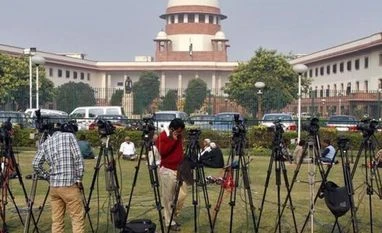
Tripods of television crew stand in front of the Indian Supreme Court building in New Delhi
Tripods of television crew stand in front of the Indian Supreme Court building in New Delhi. Photo: Reuters
Abhishek Waghmare New Delhi
Last Updated : Jan 13 2018 | 1:37 AM IST
The bone of contention in the dispute between the four senior judges of the Supreme Court and the Chief Justice of India is the internal working of the collegium system — a forum of the chief justice and the four senior-most judges —which took shape courtesy to the Supreme Court judgments in the Three Judges Cases. After Justice Dipak Misra took over as the chief justice in August 2017, the collegium decided, for the first time, to put all its resolutions online, on the website of the Supreme Court. This was to ensure transparency of the collegium system.

So far, 18 resolutions of the system have been uploaded online by the SC. The one taken on January 10 is the latest.

But what does data says about the state of justice in India?

Pendency in high courts has touched 3.4 million cases (excluding Allahabad and Jammu & Kashmir high courts) at the end of 2017, while that in the apex court has reduced to about 54,000 from more than 60,000 a year ago, according to the Supreme Court statistics. The reduction in pendency is not just due to faster disposal of cases, but a lower incidence of new cases in the first 10 months of 2017, data shows.


If the institution of new cases follows the reduced prevalence in November and December, 2017 could witness the least new cases instituted in a decade. 
 
Further, three per cent of cases in the apex court (1,550 of 54,719), 19 per cent cases in the high courts (0.64 million of 3.43 million) and nine per cent of the cases in district and subordinate courts are pending for more than 10 years. Overall pendency above 10 years is 8.63 per cent.

However, an analysis of 331 district and subordinate courts in the 2000-2016 period by DAKSH, a civil society organisation, shows that 56 per cent of the cases took between 10-15 years for disposal. Only 18 per cent cases were disposed in less than five years.


The sanctioned strength for high courts has increased from 906 in 2014 to 1,079 in 2017, and that for district and subordinate courts has increased by 20,214 to 22,677. But the wide gap between sanctioned strength and actual working strength has not vanished. About 37 per cent HC judge seats are not filled (395 of 1079) while 26 per cent of judges in district and subordinate courts (5,984 of 22,677) lie vacant. The availability of judges for the populace — represented by judges per million population — has improved from 17.5 in 2014 to 19.7 in 2017.

Subordinate courts are the courts that are within the reach of a common man. The required strength of judges in subordinate courts according to the recommendations of various law commission reports is above 130,000, while the sanctioned posts are 22,677, of which, only 16,693 are filled.

The thrust on the quality of judiciary infrastructure seems to have improved under the current government. A capital expenditure of Rs 25 billion has been done in the past four years to add 2,429 court halls and 4,172 residences. In 20 years to 2014, 15,000 court halls and 11,000 residences were constructed with a central funding of Rs 35 billion.

One subscription. Two world-class reads.

Already subscribed? Log in

Subscribe to read the full story →
*Subscribe to Business Standard digital and get complimentary access to The New York Times

Smart Quarterly

₹900

3 Months

₹300/Month

SAVE 25%

Smart Essential

₹2,700

1 Year

₹225/Month

SAVE 46%
*Complimentary New York Times access for the 2nd year will be given after 12 months

Super Saver

₹3,900

2 Years

₹162/Month

Subscribe

Renews automatically, cancel anytime

Here’s what’s included in our digital subscription plans

Exclusive premium stories online

  • Over 30 premium stories daily, handpicked by our editors

Complimentary Access to The New York Times

  • News, Games, Cooking, Audio, Wirecutter & The Athletic

Business Standard Epaper

  • Digital replica of our daily newspaper — with options to read, save, and share

Curated Newsletters

  • Insights on markets, finance, politics, tech, and more delivered to your inbox

Market Analysis & Investment Insights

  • In-depth market analysis & insights with access to The Smart Investor

Archives

  • Repository of articles and publications dating back to 1997

Ad-free Reading

  • Uninterrupted reading experience with no advertisements

Seamless Access Across All Devices

  • Access Business Standard across devices — mobile, tablet, or PC, via web or app

Next Story



