As the country awaits the arrival of the southwest monsoon after two years of drought, private weather forecasting agency Skymet on Tuesday revised upward its 2016 southwest monsoon forecast to 109 per cent of the long period average (LPA) from 105 predicted in April.
The forecast, if accurate, would mean that India might have its highest southwest monsoon since 1994 and rains might spill over well into October as the showers are predicted to gather steam in the second half of the June-September season.
According to Skymet's revised estimate, the rains this year would provide enough moisture not only for the kharif crops but also for the rabi farming season. The forecast has a model error of four per cent.
The LPA is the average rainfall for the monsoon for the period between 1951 and 2000. It is estimated to be 881 mm.
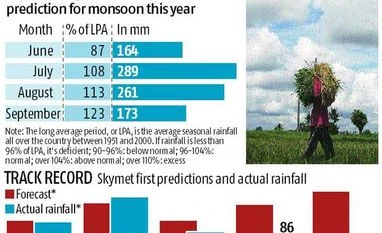
If the rainfall recorded in a year is between 96 and 104 per cent, it s considered "normal". Anything beyond is "above normal".
In April, Skymet, in its first forecast, had said the rains this year would be slightly "above normal", at 105 per cent of the LPA. Skymet is credited with correctly predicting the 2009 drought, but its first forecast of the 2015 southwest monsoon was way off the mark.
This year, too, Skymet had predicted the early onset of rains over the Kerala coast, while the India Meteorological Department (IMD) said the onset of monsoon would be delayed by almost six days.
The IMD is expected come out with its updated region-wise southwest monsoon forecast in the first week of June.
The Met department, in its April forecast, had said rains this year are expected to be "above normal" at 106 per cent of the LPA.
Jatin Singh, chief executive officer, Skymet, said the El Niño was tapering off and it would collapse after the onset of monsoon. "It is not likely to have an adverse impact on the monsoon."
El Niño is a climate cycle in the Pacific Ocean and has adversely affected the monsoon in India in recent years.
Skymet CEO Singh said there were more chances of getting into a La Niña in the later part of the year.
La Niña is another climate cycle in the Pacific Ocean, leading to cooler sea surfaces, and can have a positive effect on the monsoon.
There is over 92 per cent chance of the southwest monsoon this year being normal; a 25 per cent probability of it being excess. Rainfall is considered to be excess if it is more than 110 per cent of the LPA.
On a monthly basis, Skymet said rain in June would be 87 per cent of the LPA - about 164 mm. In July, it would be 108 per cent of the LPA. July is usually the wettest month, with average rainfall of around 289 mm. In August, according to Skymet, rainfall would be 113 per cent of average which is 261 mm; while in September, the southwest monsoon would be 123 per cent of the LPA. The average rainfall for September is 173 mm.
Skymet's forecast indicated that the southwest monsoon might gather steam during the second half of season, that is, from August and peak by the end of September.
This might also delay the withdrawal of rains and southwest monsoon might spill over well into October.
This would help not only in a good kharif harvest but could also act as a big trigger for a bumper rabi harvest, as it would leave adequate residual moisture in the soil.
On the impact of this expected good rains on kharif crops, Skymet said that total area under kharif food grains is expected to rise by 15-20 per cent and production is expected to be around 129-130 million tonnes.
The sowing for kharif is around 103 million hectares. The food grain production varies between 125-130 million tonnes. Region-wise, Skymet said that Tamil Nadu, the Northeast and interiors of south Karnataka will be at moderate risk through June, July, August and September. Good rainfall is expected in central India and along the west coast. There might be excess rainfall in some pockets of Maharashtra and Madhya Pradesh.
It also said that some pockets of Bihar and east Uttar Pradesh could experience less rainfall.
In 2014 and 2015, India suffered back-to-back droughts for the fourth time in a little over 100 years, when the southwest monsoon was 12 per cent and 14 per cent below normal, respectively. India's food grain production declined to 252.02 million tonnes in the 2014-15 crop year (July-June), from the record 265.04 million tonnes in the previous year.
The output is estimated to rise slightly to 253.16 in the ongoing 2015-16 crop year because of 14 per cent less rain.
Two consecutive bad monsoons have led to farm distress and water scarcity in the country.

 "Skymet forecasts 'above normal' rainfall")


 Connect with us on WhatsApp