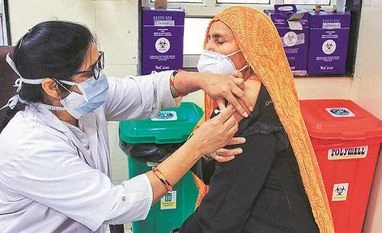
India completed 100 days of vaccination on Sunday. While achieving this landmark, less than 2 per cent of the country’s population is fully vaccinated (chart 1), and less than one in ten people have received a shot. Vaccination began early in countries that lead today. Israel has fully vaccinated more than half of its people, and is followed by the US and the UK.
In absolute terms, India stands out among the top five in the world. But it fares poorly in terms of population. Its injection-to-infection ratio is better than some European countries, but the latter are better placed in terms of the share of their population jabbed (chart 2).
A new phase of vaccination begins on May 1, which will enable everyone above 18 to get vaccinated. As we enter this phase, however, the pace of vaccination is dwindling. India gave 28.5 million doses in the 10 days ending on April 20, compared to 38.5 million in the previous 10 days (chart 3).
More importantly, India will start the new phase with a massive proportion of the 45-plus population still not vaccinated. In fact, only 36 doses have been administered per 100 people above the age of 60. For those between 40 and 60, only one in five Indians had taken the jab till April 23, according to the CoWin dashboard (chart 4). As India begins vaccinating the younger population, the most vulnerable remain largely unvaccinated.
As many as 300 million Indians are above 45. But there are twice as many people in the 18-44 age group, about 600 million. So, the new task at hand is tougher. State governments are going to play a big role, especially in financing the doses.
How much would states need to fully vaccinate 50 per cent of their eligible population (both doses), or alternatively, progress with one dose to 75 per cent people and fully vaccinating 25 per cent? India’s biggest state, Uttar Pradesh, would need to spend close to a third of its annual health budget, reveals chart 5. Kerala, Uttarakhand, Delhi and Haryana, along with most Northeastern states would manage the costs within the comfortable range of their annual health spends.
Faster vaccination will mean less economic losses. The second wave of Covid-19 has already affected the economy, and agencies are cutting down 20-40 basis points from the expected GDP growth this financial year. Most of the losses would be visible in manufacturing, trade, hospitality and transportation among services, Care Ratings has said in a note (chart 6).

 "Statsguru: 1 in 10 got a shot as India completes 100 days of vaccination")











