
Sushma Swaraj starts five-day South Africa tour, to attend multiple summits
The year marks the 25 years of the establishment of diplomatic relations between India and South Africa
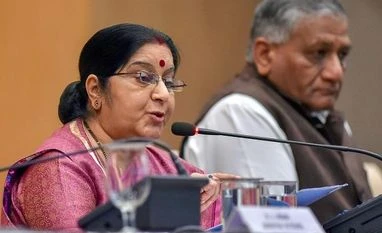 "Sushma Swaraj starts five-day South Africa tour, to attend multiple summits")
WebinarsNew
Deep DiveNew
Explore Business Standard
The year marks the 25 years of the establishment of diplomatic relations between India and South Africa
External Affairs Minister (EAM) Sushma Swaraj, who is on a five-day visit to South Africa, reached Johannesburg on Sunday evening.
During the visit, Swaraj is expected to have meetings with the top leadership of South Africa, participate in the BRICS Foreign Ministers Meeting on June 4 and chair the IBSA Foreign Ministers Meeting, a statement issued by the Ministry of External Affairs (MEA) on June 2 read.
BRICS is a grouping of five countries-Brazil, Russia, India, China and South Africa and IBSA is a tripartite grouping of India, Brazil, South Africa.
During her visit, the EAM, on June 6, will visit the Phoenix Settlement, a South African Heritage site, a place where Mahatma Gandhi developed his philosophy of non-violence.
She would also participate in a series of events at Pietermaritzburg, South Africa, on June 6-7 to commemorate the 125th anniversary of the "historic incident in the train compartment that became a catalyst for Gandhiji's Satyagraha movement."
"The two-day commemoration activities will also include the release of joint commemorative stamps on Oliver Tambo and Pt Deen Dayal Upadhayaa and a Youth Summit where 20 diaspora youth from Africa and 5 from India will participate to speak on the relevance of Gandhiji's message of peace to the youth of today," the statement added.
The year marks the 25 years of the establishment of diplomatic relations between India and South Africa.
It also marks the 125th anniversary of the Pietermaritzburg railway station incident and the 100th birth centenary of South African leader Nelson Mandela.
At the Pietermaritzburg railway station, Mahatma Gandhi was thrown off from a train on June 7, 1893, while travelling from Durban to Pretoria in the first compartment. It is considered as his first civil disobedience act since he had refused to vacate his seat in the first class coach despite having the ticket for it. Following non-compliance, the railway authorities threw him off the train at the station.
First Published: Jun 03 2018 | 9:44 PM IST

