The strangely magnificent technology used to capture the black hole on film

Black holes tend to be very massive but very small in volume
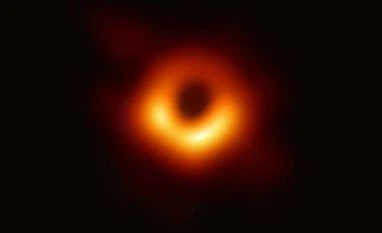
Black hole
Black hole | Photo: National Science Foundation (Twitter)
Devangshu Datta
4 min read Last Updated : Apr 12 2019 | 10:26 PM IST
To understand the importance of the black hole images released by the Event Horizon Telescope (EHT) group, we have to go back all the way to 1915. That was when Albert Einstein published the General Theory of Relativity (GTR). 

The GTR studied the effects of mass on space-time. Think of a hammock — that is space-time. If you lie in the hammock, it folds up round you, and it is hard to get out of the depression caused by your own body. That is the effect mass has on space-time. Masses create “gravity wells” that are hard to climb out of. 

The GTR implied some things Einstein himself was reluctant to believe. One was that a body could become so massive that it created a gravity well that was impossible for even light to escape. This is a black hole — an object invisible by definition. As it absorbed more matter, it would become more massive and create more gravitational disturbance. 

It was discovered that such objects existed. Astronomers located them by observing the movements of stars. There tends to be a supermassive black hole at the centre of each galaxy. GTR made a few predictions on what these black holes would be like. The LIGO (Laser Interferometer Gravitational-wave Observatory) has identified black hole mergers.


When stars run out of fuel, they collapse. The matter becomes densely packed. A star more massive than the “Chandrasekhar Limit” (named after Subrahmanyan Chandrasekhar who calculated this) will turn into a black hole. The region just beyond the point where gravity is inescapable is the “event horizon”. 

Black holes tend to be very massive but very small in volume. The smaller an object, the larger the lens (or mirror) required for a telescope to see it. The Virgo A (or M87) black hole is 55 million light years away and smaller than the solar system. A telescope that could see it would need a mirror that was Earth-sized. It would have to be powerful enough for a person sitting in New York to read a newspaper in Paris. 

However, instead of using just one very large telescope, we can use multiple smaller telescopes to see such an object by stitching many images together. The EHT used a technique called Very Long Baseline Interferometry (VLBI) to pick up and synchronise data (taken at exactly the same time using atomic clocks) from eight different telescopes located across four different continents. These are in exotic places such as on top of volcanoes, and in Antarctica. These are actually radio telescopes — they “see” in radio waves, not visible light. 


In April 2017, this array generated 5,000 terabytes of data with two black holes as targets. That’s so much data that it had to be stored in special hard drives and carried out physically. But even this doesn’t give a complete picture — it’s like a puzzle with many missing pieces. 

Since nobody knew what a black hole looked like, filling in the missing details was hard. As Katie Bouman, one of the computer scientists who developed those algorithms, said, “If there’s a giant elephant there, we want to find it.”

Four different teams processed the data independently, without consulting each other. This was to ensure biases would be eliminated. If the four teams using different algorithms came up with similar images, the chances are those images would be correct. This data processing took over two years. 

What we “see” validates Einstein’s intuition about the size and shape of event horizons. M87 is a super-massive black hole with the mass of 6.5 billion suns — it’s the black pupil in that “Eye of Sauron”. The orange-yellow ring is superhot matter around the event horizon. The hotter bits have been coloured yellow and the cooler bits (which are also very hot) have been coloured orange by the algorithms. 

EHT is adding more radio telescopes to its array. It will also use more frequencies in future. This will produce more data, which can be used to develop clearer images and give us more insights into these strange objects. The EHT team consists of 200-plus scientists spread across 13 different institutes and multiple disciplines. The computer algorithms will surely find application in other areas as well. This is a triumph of modern collaborative science.

One subscription. Two world-class reads.

Already subscribed? Log in

Subscribe to read the full story →
*Subscribe to Business Standard digital and get complimentary access to The New York Times

Smart Quarterly

₹900

3 Months

₹300/Month

SAVE 25%

Smart Essential

₹2,700

1 Year

₹225/Month

SAVE 46%
*Complimentary New York Times access for the 2nd year will be given after 12 months

Super Saver

₹3,900

2 Years

₹162/Month

Subscribe

Renews automatically, cancel anytime

Here’s what’s included in our digital subscription plans

Exclusive premium stories online

  • Over 30 premium stories daily, handpicked by our editors

Complimentary Access to The New York Times

  • News, Games, Cooking, Audio, Wirecutter & The Athletic

Business Standard Epaper

  • Digital replica of our daily newspaper — with options to read, save, and share

Curated Newsletters

  • Insights on markets, finance, politics, tech, and more delivered to your inbox

Market Analysis & Investment Insights

  • In-depth market analysis & insights with access to The Smart Investor

Archives

  • Repository of articles and publications dating back to 1997

Ad-free Reading

  • Uninterrupted reading experience with no advertisements

Seamless Access Across All Devices

  • Access Business Standard across devices — mobile, tablet, or PC, via web or app

Next Story



