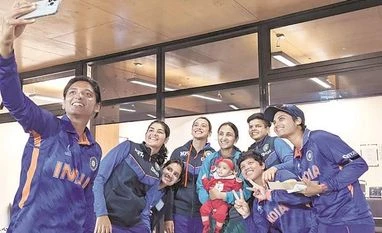
Maybe the best way to understand a picture is to sometimes consider everything outside its restricted frame, everything that happened before. Consider, for instance, that picture from Sunday: Pakistan captain Bismah Maroof holding her infant, surrounded by her Indian counterparts, all of them cooing and wooing the kid in the frame, on the sidelines of the ongoing Women’s World Cup at New Zealand. The picture taken at the Bay Oval, Mount Maunganui, is a portrait of what sport is and what women who play it go through together.
Maroof returned to cricket six months after having a baby and has seamlessly integrated into the national team. On Tuesday, in Pakistan’s game against Australia, as she scored a half-century — her first since the baby — she celebrated, looking at the dressing room, playacting, as though rocking an infant in her arms. The camera cut to the dressing room and there she was, the infant Fatima, this time held up by her beaming grandmother for the world to see.
Ten minutes later, Sana Mir, Pakistan’s former captain, an all-time great who practically dragged women’s cricket in the country by the collars (of the men who run the game) to where it is today, beamed in pride. “I hope there are many women watching this, getting inspired. Young girls, too,” she said. “I hope Fatima becomes a cricketer someday, too. Women can do everything they want to do, if you give them the platform to do so.”
One of the factors that facilitated Maroof’s return to international cricket is the Pakistan Cricket Board’s (PCB’s) maternity support policy initiated last year (see box). So far, India doesn’t have such a policy.
Pause. Rewind, way back. Play again. It’s 2012, at the Karnail Singh Stadium in Paharganj, Delhi. A wiry, petite boxer is skipping in the ring, coolly and patiently, for a photographer looking for the perfect shot.
Two four-year-olds, her kids, twins, run around the arena. The boxer is a five-time World Champion about to make her debut at the Olympics in London: Mary Kom.
“It’s tough to come back and compete after having children,” Mary Kom says to the trio of journalists present there, one wary eye on the kids. She talks about the weakness, the aches and pains that persist four years later, especially in her back. She recalls how she stopped breastfeeding after a year, so she could train.
A month later, she wins her opening bout on the twins’ fifth birthday, and comes back from the Games with a bronze, a living legend, immortalised on celluloid. After that she will win one more World Championship title — the most by a woman in the sport. She will have another kid, a boy, adopt a girl and come within a whisker of another medal at her second Olympics in Tokyo.
Between Kom, Maroof and that picture, there are countless other women, elite athletes, professionals who have had to forsake careers, struggle through on sheer willpower to make careers after childbirth. L Sarita Devi, Kom’s contemporary and a former World Champion (2006), remembers her struggles to get back into the fold after giving birth to her son, Tomthin, in 2013. “Once you have a kid, everyone thinks you’ve retired,” she laughs. “Suddenly, coaches will look at you differently. Nobody will say anything straight, but they are all thinking the same thing: That you are done.” Sarita remembers having to train and regain fitness by herself, while her husband took charge of her toddler, so she could make it to the 2014 Asian Games (she won a hugely controversial bronze).
No protections exist either. The Board of Control for Cricket in India (BCCI) contracts its players but in the absence of an independent player-led committee, there is little space to negotiate paid leave or maternity benefits into contracts. Athletes from other sports are not employed by federations or associations. Their employers — in most cases public sector undertakings (PSUs) — offer different forms of paid leave, but these do little to protect, extend and aid their sporting careers.
In 2018, amidst the fallout of Serena Williams’ return after giving birth to her daughter — her ranking plummeted to 453 in one year — the Women’s Tennis Association (WTA) introduced policies to protect the rankings of women returning to the tour after childbirth. It took till 2020 for the Women’s National Basketball Association (WNBA) to include fully paid maternity leave into player contracts. FIFA followed suit even later (albeit assuring only two-thirds of full pay), in the middle of the pandemic.
Policies are one thing, application another. Chitra Gangadharan, head coach at Bengaluru United Women, says on the ground, in India at least, maternity leave and support is a long way away. “Women players are handed short-term contracts,” she says. “It’s competition to competition. The question of leave doesn’t exist.”
“Women in India have gone through so much trying to achieve something or excel at something,” Indian goalkeeper Aditi Chauhan said in a webinar organised by the All India Football Federation (AIFF) to recognise Women’s Day.
“We want to support women’s football in a big way,” ATK Mohun Bagan’s finance director Debasis Dutta said on the sidelines of the Kanyasree Cup in Kolkata, a fortnight prior. A generous statement. But then he added, “This way, when they have children, these genes will be passed on. Football will grow this way.”
As women in sport plough on, a clear policy framework is in order.