The state is being overrun by a contractor-driven rush of roads, dams and tourism eyesores. To protect its fragile ecosystem, it must learn to reject projects that cause irreparable damage for questionable benefits, writes Himraj Dang
Sikkim is a land of contrasts. Nature is bountiful and people are friendly. State capacity is impressive and idealism in public service is alive. And yet, even after a tidal wave of prosperity has deposited much affluence, education, and infrastructure, Sikkim is hardly making the transition to enlightened and enhanced environmental management. This has negative consequences for the state and the rest of India.
The green critique of Sikkim has to surely be its inability to say “No”. After having achieved a raft of economic successes — the first state to launch universal basic income, in the top five tier of states ranked by per capita income, highest per capita transfers by the central government, 90 per cent-plus literacy, 100 per cent electrification, 100 per cent organic farming, etc— one would have expected a small state, with strong community organisations and a diverse and vibrant democratic culture to assert itself and selectively reject certain kinds of development. This has not happened, and the typical pan-Indian, contractor-driven rush of roads, dams, tourism eyesores, explodes and assaults the senses. This is absent in Bhutan and Ladakh, no less affluent and no less strategic for Indian defence.
The power sector is the most glaring example of runaway development. Sikkim hosts some 2,200MW of operating hydro projects, soon to rise to 3,000MW. These are large projects, recently commissioned, and they export most of the power generated out of state. These large dams, primarily on the Teesta and Rangeet rivers, have created enormous environmental problems. The poster child of such projects is Teesta Urja’s Teesta III 1,200MW project at Chungthang, now majority owned by the Government of Sikkim, the construction of which has seen, besides embarrassing financial shenanigans worthy of a soap opera, landslides from road construction, deaths of labourers in the tunnel during the 2011 earthquake, the collapse of a bridge by an overloaded truck carrying materials for the projects, disputes over non-construction of fish ladders, issues around e-flow of river water, shareholder disputes, take-over by the government and a long list of social and environmental failures.
Conversations with enough Sikkimese convince me they now have had enough of dams for such a small state, and certainly do not need any more power, with less than 100MW used within the state. And, yet, developers are still eyeing another project on the Teesta, which already has over a dozen large projects operating, and Teesta VI (500MW) has just recently transferred from bankrupt Lanco to NHPC for completion. There is also the case of the infamous to-be-constructed Teesta IV project in Dzongu, the Lepcha reserve. Predictably, there is near-total local opposition which has coalesced around this project in a sensitive location.
In contrast, the 780-MW Nyamjang Chu project in Arunachal has recently been cancelled, after a successful, lengthy agitation by the local Mon community, making the case for the conservation of the endangered Black-necked Crane. Small and strategically important community, border area, arcane environmental argument, and, yet, an environmental success. Sure, after 10 years, but still a success, a community taking charge and voicing its own priorities. Can this be replicated in Sikkim?
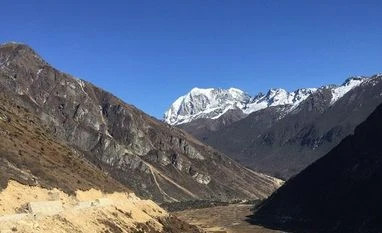
Another case in point is the new road up the Chopta Valley to and across the Lugnak La pass into Lhonak. Note, this is not on or near the border. In fact, the area this leads to, Lhonak, is patrolled by the ITBP, not the Army, for that reason. This road was justified for supporting the military, and the objections of the Forest Department were typically overrun. There was a very good footpath which went along the valley and gave perfect access to Muguthang; first, an attempt was made to widen it. When that failed, a massive road project was started and resulted in being totally annihilated by landslides, destroying a large area of dwarf Rhododendron and Juniper. This new road failed.
Finally, the third programme of road construction went ahead, and I drove on this last autumn. The road was very poorly constructed, with water flowing down it in the absence of even water channels on the side, eroding the very road constructed. The picture that emerges is of the enormous damage done and continuing from this poorly-planned road in the fragile country — three roads in one valley. Someone should really justify why such a road was needed, away from the border, and not of great strategic value. It cannot be that all of Sikkim is of strategic value and that every road is welcome or necessary. That Sikkim must pay the ecological costs for India’s national security even if mainstream India wishes to trample upon its own ecological security.
All the tourists who now go to Gurudongmar, and this can be 300 vehicles a day in the peak season, scarcely notice the tanks, trucks, and large military facilities at Giagong and beyond. This area has a highly sensitive trans-Himalayan ecology, with extremely slow plant growth, given the temperature and wind conditions. Damage to plant and associated bird and animal life here is irreversible.
I am sure these tanks and trucks are needed for the defence of the borders, but can we not avoid the feral dogs coming up on the trucks, which have interbred with the local mastiffs and exterminated them? How is the military disposing of its sewage and garbage, which is seen littering the gorgeous landscape? And, finally, is dialogue possible, to have the tanks avoid areas with specifically-identified breeding animals and birds?
Would that not be a solution, an accommodation respecting nature, culture, and the highest traditions of the most disciplined military in the world? The military presence was increased here in the 1980s by remarkable officers like Gen R K Gaur and Brig Baljit Singh, who were both unashamed naturalists. With a bit of imagination and mutual respect, so much is possible to find enlightened solutions. And we are not even talking to each other. The proposal to conserve the area around Tsolhamo lake as a high-altitude sanctuary was rejected and the forest department overruled, even as this area is being progressively opened to tourism.
In Garhwal, the army has created a Territorial Army eco-battalion, which is engaging retired personnel in planting trees. You can see them on the once-ravaged hillsides on the way from Dehra Dun to Mussoorie. Could a unit like that be set up in Sikkim to remove the obsolete mines and fences which are away from the border, way past their useful life? Some of the outdated and unmarked mines keep drifting and hurting animals and shepherds, and as such, have no useful military purpose.
I would like to bring one more example: The dams proposed at Lachen and Lachung, the prettiest high-altitude villages in North Sikkim. Locals were not consulted, efforts were made to co-opt the local dzumsa (or traditional, local body for self-government), and surveys began. When the “managed EIA” was to be conducted, the officials and engineers were actually locked up and then thrown out. The projects were shelved or cancelled. Is this how we are going to resolve our disputes? In peaceful Sikkim?
This is the Nyamjang Chu solution, where a monk was jailed, peaceful protestors killed by the police, and a whole community turned against Indian democracy. Eventually, the National Green Tribunal ruled in favour of the opposition to the dam, and the dam is history. Such a massive forest fire of local opposition is going to spread everywhere, as the state loses its authority, by itself undermining the laws and regulations, with which we govern ourselves.
Before we blame the government of India alone, Sikkimese should also examine their own management of urban development. Can Gangtok, Ravangla, and Peling grow further? Where will the water come from? With such a massive build-up of concrete, what have we learnt from the last earthquake? And why is all development along the road, jamming up the small towns and creating traffic congestion even in remote places? Is there any thought to carrying-capacity for tourism in limited geographies?
And as for the disease of gigantism, that giant ropeway eating up mature oak-and-rhododendron forest has now reached Bhaleydunga, apiece with the construction of the Sardar Patel statue, and others large statues to come up in Mumbai and Ayodhya. What more can anyone say to such developments?
Sikkim must ask itself what it means to be a green state. To show up happy smiling children in a still massively forested state? Or, using reason, science, and dialogue, to sieve through the good projects and the bad ones. To respect community opinion and not let social conflagrations build up with its own people. To respect rules, regulations, and EIA processes. And, yes, to occasionally reject a few projects which cause irredeemable damage for questionable benefit. In other words, to learn to say “No.” Sikkim can afford it, and India should be grateful for the learning, to help us all choose between development we all want and mindless growth we do not need.