On Saturday, two days after the Pakistan-based Jaish-e-Mohammad (JeM) terrorist group orchestrated a deadly suicide car bombing in Kashmir that killed some 40 troopers from the Central Reserve Policy Force (CRPF), 137 aircraft from the Indian Air Force (IAF) struck ground targets 200 kilometres due south of Bahawalpur, the headquarters of the JeM.
This was not retaliation. The targets struck were well inside India, in the Pokhran Field Firing Range. This was a pre-planned exercise called Vayu Shakti, which the IAF carries out once every three years, to demonstrate it is equipped, rehearsed and ready for action. It has been rehearsing Exercise Vayu Shakti for almost a month.
Business Standard learnt diplomats from these two countries were not issued invitations to the demonstration.
Smoke rises from an explosion during an IAF exercise named 'Vayu Shakti-2019', at the Air Force firing range of Pokhran, Rajasthan | Photo: PTI
Exercise Vayu Shakti was mostly about displaying the IAF’s ability to strike targets on the ground — such as enemy convoys and tanks, radar stations, railway yards and military headquarters. The other important dimension of air power, air-to-air combat, had been practiced a few months ago in a large IAF exercise called Gagan Shakti.
Dhanoa did not miss the opportunity to correlate Vayu Shakti with the recent events in Kashmir.
Thereafter, the Pokhran Ranges resonated with explosions as each of the IAF’s fighter aircraft struck a variety of simulated targets with unerring accuracy. For the first time, the MiG-29UPG — an air-to-air fighter that has now been upgraded to a multi-role aircraft — showcased its new ground strike capability.
Also featuring for the first time was the swing role capability of the Tejas fighter, which fired a missile at an enemy aircraft and also struck a ground target in the same mission. The indigenous Akash missile also engaged and directly hit a simulated aircraft target by night.
Exercise Vayu Shakti is conducted once every three years. This firepower demonstration was earlier conducted at the Tilpat Ranges outside Delhi. But, after 1989, it was shifted to Pokhran Ranges where more land is available.

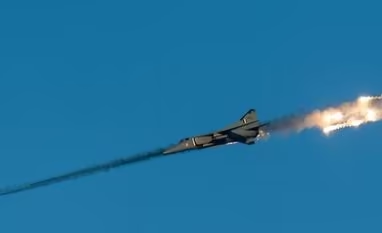 "Vayu Shakti 2019: Air Force demonstrates mega firepower at Pokhran")












 Connect with us on WhatsApp