'Veere Di Wedding': Another chick flick with a dazzling marketing strategy

Veere Di Wedding has ended up being a noisy story about a bunch of women bandying cusswords and basking in their privilege
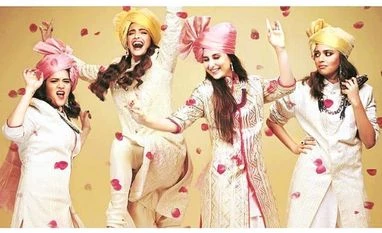
Veere Di Wedding
Their impertinence would have meant more if these educated and privileged women asked deeper questions, but this attempt remains half-hearted
Manavi Kapur
Last Updated : Jun 02 2018 | 12:36 AM IST
What happens when four women who grew up together meet for a wedding, swear, drink and curse societal hypocrisy? You get Veere Di Wedding, an ambitious film with a dazzling marketing strategy. Produced by Rhea Kapoor and Ekta Kapoor and directed by Shashanka Ghosh, the two-hour film could well have been just an hour long, or even a short episode of a Web series. But since the producers chose that length — probably to allow their actors to flaunt their trendy wardrobes — this review must needs go beyond the gist of the film, too.

Starring Kareena Kapoor Khan, Sonam K Ahuja, Shikha Talsania and Swara Bhasker, Veere Di Wedding is a filmi version of “Girls Just Want to Have Fun”. Rishabh Malhotra (the pitch-perfect Sumeet Vyas) proposes to Kalindi Puri (Khan), a young woman scarred by her parents’ dysfunctional marriage. Kalindi acquiesces and thus begins the great (North) Indian wedding drama. Where ultra-rich Delhiites share preposterous jokes about “selling kidneys” to buy lehengas and where the size of the solitaire on the ring determines social status.

Bollywood has lately tried to explore the female friendship trope, and some films, like Queen and Dor, have come close to being successful. Homi Adajania’s Cocktail, too, gave it a shot, but fell short of genuinely thoughtful enquiry. Veere Di Wedding is more sure-footed than Cocktail in its commentary on female friendship, especially in the manner in which Kalindi, Avni (Ahuja), Sakshi (Bhasker) and Meera (Talsania) are shown to have grown up as essential parts of each other’s families. Neena Gupta as Avni’s nitpicking mother is delightful, as is Vivek Mushran essaying the role of Kshitij Puri, Kalindi’s uncle. His gay partner, Keshav, is played by Sukesh Arora, who brings a certain subtlety to an otherwise shrill movie.

Though Nidhi Mehra and Mehul Suri have written an interesting plot, the highlight of their endeavour seems to be the freedom with which their women leads use cusswords, knock back stiff drinks and generally thumb their collective nose at traditions and customs. Their impertinence would have meant more if these seemingly intelligent, educated and privileged women asked deeper questions — such as the relevance of the institution of marriage itself — but this attempt remains half-hearted. For instance, Bhasker’s character as the irreverent Sakshi never goes beyond an obnoxious profanity, especially since there is no explanation for her bratty behaviour other than a spoilt upbringing.

For a film that made waves even before its shoot began — Khan’s pregnancy put a halt to the filming — which was then followed by a clever social media marketing strategy, Veere Di Wedding is a disappointment. The punch lines, as is the norm with most films today, are largely revealed in the trailer and there isn’t enough meat in the script to last the length of the film. The background score is catchy, particularly because of the familiarity engendered by promotional videos, but it tends to create more din than anything else.

Veere Di Wedding loses steam simply because it is a confused plot, trying to handle too much at once and not giving any single plot angle the focus it deserves. Rife with stereotypes about Bengali women and West Delhi folks, the humour is slapstick. But one can’t say it is entirely boring. The film has its moments and the drama behind Kalindi and Rishabh’s wedding is as real as it gets, at least in Delhi.

Ahuja and Khan are the big-ticket “superstars” for whom the filmmakers saved the spotlight, but Talsania, Bhasker and Vyas stand out as the real stars with understated performances. Vyas, in particular, has a charming screen persona that gels well with the muted character Khan plays.

Rhea Kapoor went to great lengths to declare that Veere Di Wedding was not a chick flick. In this Sex and the City and Bridesmaids crossover, the film ends up being exactly that — a rom-com chick flick with the twist of potty-mouthed, sexually licentious characters. If you’re watching this film, expect no more than the self-declared “non-feminism” espoused by Khan and Ahuja’s generation.

One subscription. Two world-class reads.

Already subscribed? Log in

Subscribe to read the full story →
*Subscribe to Business Standard digital and get complimentary access to The New York Times

Smart Quarterly

₹900

3 Months

₹300/Month

SAVE 25%

Smart Essential

₹2,700

1 Year

₹225/Month

SAVE 46%
*Complimentary New York Times access for the 2nd year will be given after 12 months

Super Saver

₹3,900

2 Years

₹162/Month

Subscribe

Renews automatically, cancel anytime

Here’s what’s included in our digital subscription plans

Exclusive premium stories online

  • Over 30 premium stories daily, handpicked by our editors

Complimentary Access to The New York Times

  • News, Games, Cooking, Audio, Wirecutter & The Athletic

Business Standard Epaper

  • Digital replica of our daily newspaper — with options to read, save, and share

Curated Newsletters

  • Insights on markets, finance, politics, tech, and more delivered to your inbox

Market Analysis & Investment Insights

  • In-depth market analysis & insights with access to The Smart Investor

Archives

  • Repository of articles and publications dating back to 1997

Ad-free Reading

  • Uninterrupted reading experience with no advertisements

Seamless Access Across All Devices

  • Access Business Standard across devices — mobile, tablet, or PC, via web or app

Next Story



