5 million men lost their jobs after demonetisation, says SWI 2019 report

Though the report does not establish any causal link with the note ban, it says the labour force participation started falling suddenly between September and December 2016 for both urban and rural men

5 million men lost their jobs after demonetisation, says SWI 2019 Report
BS Web Team
3 min read Last Updated : Apr 17 2019 | 2:40 PM IST
According to an analysis by Bengaluru-based Azim Premji University researchers, five million men lost their jobs between 2016 and 2018. The beginning of the decline in unemployment coincided with Prime Minister Narendra Modi's demonetisation of high-value currency notes on November 8, 2016.

The university released its State of Working India 2019 (SWI 2019) report here on Tuesday, adding to the already raging debate over employment generation at a time when India votes to elect a new government.

The government has not released the results of the new high-frequency Periodic Labour Force Survey (PLFS) conducted by the National Sample Survey Office (NSSO). In its absence, the researchers have used data from the Consumer Pyramids Survey of the Centre for Monitoring the Indian Economy (CMIE-CPDX) to understand the employment situation between 2016 and 2018. The CMIE-CPDX is an ongoing nationally representative panel survey of around 160,000 households, conducted every four months.

According to the report, the labour force participation started declining suddenly between September and December 2016 for both urban and rural men.

The rate of decline slowed down by the second half of 2017, but the general trend had continued and there had been no recovery, SWI 2019 said, adding that though the timing of the decline coincided with demonetisation in November 2016, the researchers could not bring any causal link based on these trends. The Work Participation Rate (WPR) declined as well but not as sharp as the Labour Force Participation Rate (LFPR).

SWI 2019 found that between January to April 2016 and September to December 2018, the urban male LFPR fell by 5.8 percentage points while the WPR for the same group fell by 2.8 percentage points.

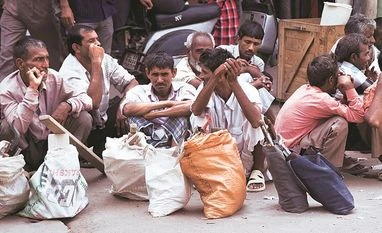
The SWI report states that the unemployment rate has steadily increased to around 5 per cent in 2015 and then just over 6 per cent in 2018. Both the PLFS and the CMIE-CPDX report the overall unemployment rate to be around 6 per cent in 2018, double of what it was in the decade from 2000 to 2011.

The researchers have observed that India’s unemployed are mostly the higher educated and the young. Among urban women, graduates are 10 per cent of the working age population but 34 per cent of the unemployed. The age group 20-24 years is hugely over-represented among the unemployed. Among urban men, for example, this age group accounts for 13.5 per cent of the working age population but 60 per cent of the unemployed.

In addition to rising open unemployment among the higher educated, the less educated (and likely, informal) workers have also seen job losses and reduced work opportunities since 2016.

Women are much worse affected than men. They have higher unemployment rates as well as lower labour force participation rates, SWI 2019 reported.

Among urban women, graduates are 10 per cent of the working age population but 34 per cent of the unemployed, whereas, graduates form only a small 3.2 per cent of the working age population among rural women, but they make up 24 per cent of the unemployed.

The first few months of 2019 have been unusually eventful for labour economists and statisticians in India, started with a document reviewed by Business Standard, where it showed that the unemployment rate was at its highest level since 1972-73 – a period from when the jobs data is comparable.

One subscription. Two world-class reads.

Already subscribed? Log in

Subscribe to read the full story →
*Subscribe to Business Standard digital and get complimentary access to The New York Times

Smart Quarterly

₹900

3 Months

₹300/Month

SAVE 25%

Smart Essential

₹2,700

1 Year

₹225/Month

SAVE 46%
*Complimentary New York Times access for the 2nd year will be given after 12 months

Super Saver

₹3,900

2 Years

₹162/Month

Subscribe

Renews automatically, cancel anytime

Here’s what’s included in our digital subscription plans

Exclusive premium stories online

  • Over 30 premium stories daily, handpicked by our editors

Complimentary Access to The New York Times

  • News, Games, Cooking, Audio, Wirecutter & The Athletic

Business Standard Epaper

  • Digital replica of our daily newspaper — with options to read, save, and share

Curated Newsletters

  • Insights on markets, finance, politics, tech, and more delivered to your inbox

Market Analysis & Investment Insights

  • In-depth market analysis & insights with access to The Smart Investor

Archives

  • Repository of articles and publications dating back to 1997

Ad-free Reading

  • Uninterrupted reading experience with no advertisements

Seamless Access Across All Devices

  • Access Business Standard across devices — mobile, tablet, or PC, via web or app

Next Story





