Ahead of Modi's Berlin visit, Germany insists on India's FTA talk with EU

PM Modi is to visit Germany on May 29 and 30
Narendra Modi
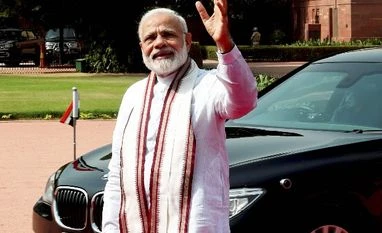
Prime Minister Narendra Modi waves to media as he leaves after the ceremonial reception of Palestinian President Mahmoud Abbas, in New Delhi on Tuesday. (Photo: PTI)
Archis Mohan New Delhi
Last Updated : May 24 2017 | 12:51 AM IST
Germany urged India on Tuesday to resume negotiations on the European Union (EU) - India free trade agreement (FTA), especially in the context of India not taking part in the One Belt One Road (OBOR) summit that China hosted earlier this month.

The other EU member countries are also hesitant to sign that trade declaration.

Prime Minister (PM) Narendra Modi is set to visit Germany on May 29 and May 30 for the fourth biannual India-Germany inter-governmental consultations. 

The lack of progress on the EU-India FTA is likely to come up during Modi’s talks with German Chancellor Angela Merkel in Berlin.

Not just because of OBOR-related strategic reasons, German Ambassador to New Delhi Martin Ney said the need for the EU-India FTA was so much greater now that New Delhi had terminated its Bilateral Investment Treaties (BITs), and there was no treaty protection under international law to future investments in India and vice versa.

“If you want to shape globalisation, you do it by writing it into treaties,” Ney said, urging the European Commission and India to “sit down as soon as possible” to negotiate the FTA. The Ambassador said the India-Germany BIT expired in March. As a result, the existing investments from India into Germany or German investments into India will be protected for 15 years under the old BIT, but the new investments will not have any protection until a fresh treaty is formalised.

India has terminated bilateral investment treaties, or BITs, it had signed treaties with 58 countries, including Germany. 

New Delhi intends to renegotiate these BITs under its new BIT model. But, since EU members have entrusted the responsibility of BITs with EU, the new treaty will now need to be signed between India and EU and not individual countries.

The German ambassador said that OBOR was a China-centred trade enhancement system. He said India had not participated in the OBOR Summit, while EU member states have not signed to the trade declaration of OBOR. “If both the EU and India have certain hesitations about it, it should give us an extra incentive to sit down and resume negotiations on a free trade agreement,” Ney said.

The Ambassador pointed out that in the last India-Germany inter-governmental consultations in New Delhi n 2015, both Modi and Merkel “spoke out strongly in favour of resuming FTA negotiations between the EU and India.” Ney said the EU was India’s largest trading partner.

The German Ambassador said India and Germany were set to sign several agreements during the PM’s visit to Berlin. 

These would cover areas of trade, investment, renewable energy, vocational training and strengthening defence cooperation. Germany has also offered concessional finance to India for building high speed railways.

The PM will be accompanied by a ministerial delegation from India. The PM will also inaugurate the Indo-German business forum to be attended by top German industrialists. Ney said Germany appreciated Indian government’s efforts towards ensuring ‘ease of doing business’. The German Ambassador said German companies have invested Rs 53,000 crore in India since 2010, with Rs 8,121 crore in 2016. He said 1,800 German companies were operating in India. Germany was also India’s largest development partner and contributed Rs 7,000 crore aid to India annually.

Ney said Berlin supports India’s aspiration to join the Nuclear Suppliers Group and other export control regimes. On the South China sea dispute, he said India and Germany’s views converge on ensuring freedom of navigation in international waters. Germany is highly interested in the Indian Ocean Region,” he added.

One subscription. Two world-class reads.

Already subscribed? Log in

Subscribe to read the full story →
*Subscribe to Business Standard digital and get complimentary access to The New York Times

Smart Quarterly

₹900

3 Months

₹300/Month

SAVE 25%

Smart Essential

₹2,700

1 Year

₹225/Month

SAVE 46%
*Complimentary New York Times access for the 2nd year will be given after 12 months

Super Saver

₹3,900

2 Years

₹162/Month

Subscribe

Renews automatically, cancel anytime

Here’s what’s included in our digital subscription plans

Exclusive premium stories online

  • Over 30 premium stories daily, handpicked by our editors

Complimentary Access to The New York Times

  • News, Games, Cooking, Audio, Wirecutter & The Athletic

Business Standard Epaper

  • Digital replica of our daily newspaper — with options to read, save, and share

Curated Newsletters

  • Insights on markets, finance, politics, tech, and more delivered to your inbox

Market Analysis & Investment Insights

  • In-depth market analysis & insights with access to The Smart Investor

Archives

  • Repository of articles and publications dating back to 1997

Ad-free Reading

  • Uninterrupted reading experience with no advertisements

Seamless Access Across All Devices

  • Access Business Standard across devices — mobile, tablet, or PC, via web or app

Next Story



