Home / Economy / News / Anyone can do marketing; Gail's job is to lay gas pipelines, says Pradhan
Anyone can do marketing; Gail's job is to lay gas pipelines, says Pradhan
The minister also said the Rajasthan govt was set to save at least Rs 400 bn from the revised viability-gap funding for its Barmer refinery project by HPCL
premium
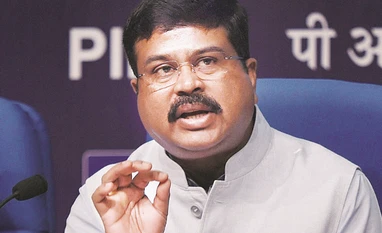
Dharmendra Pradhan (pictured) and MoS Ananthkumar Hegde have been appointed to the Ministry of Skill Development and Entrepreneurship.
Union Petroleum Minister Dharmendra Pradhan on Tuesday said the primary job of state-run company Gail was to lay gas infrastructure in the country; marketing could be “done by anyone”.
The government is reportedly planning to spin off Gail’s marketing operations into a separate company. Under the Petroleum and Natural Gas Regulatory Board Act, marketing and transmission functions should not be performed by the same entity, so that there is no conflict of interest. This is so especially because companies like Gail are in a position to push their gas on priority, given that they also run pipelines as transmission entities.
Following the legal requirement, Gail did not spin off its marketing business but decided to maintain a split of its business and accounts for marketing and transmission businesses.
Pradhan added that Gail had kicked off the Urjja Ganga programme and should emphasise providing gas infrastructure in eastern India — connecting Uttar Pradesh, Bihar, Jharkhand, Odisha and West Bengal. “We have committed a gas-based economy to the country and are moving closer to that. The Eastern India project of Gail is vital for the industrial belt, especially the upcoming steel plants in that region. We are giving a viability-gap (funding) for a gas infrastructure project for the first time,” he added.
Earlier, Indian Oil Corporation (IOC) and Bharat Petroleum Corporation Ltd (BPCL) were also looking at a takeover of Gail. The plan to bifurcate the company had been discussed earlier as well, during the tenure of the Atal Bihari Vajpayee-led National Democratic Alliance government at the Centre.
Rajasthan to save Rs 400 bn on revised Barmer refinery plan
The minister also said that the Rajasthan government was set to save at least Rs 400 billion from the revised viability-gap funding for the Barmer refinery project by the Hindustan Petroleum Corporation (HPCL). Prime Minister Narendra Modi is set to lay the foundation stone for the project on January 16.
“The earlier agreement by the Congress government was bringing a huge loss to Rajasthan. The internal rate of return from the project was around 6 per cent earlier, with a viability-gap funding of Rs 37 billion per year from the state government for 15 years. Now, the rate of returns for the revised project comes to around 12 per cent, with an annual support of Rs 11 billion by the state,” he said.
During the time of the Congress-led United Progressive Alliance (UPA) government, the party’s then president Sonia Gandhi had laid the foundation stone for the refinery on September 22, 2013, a few days before the Model Code of Conduct for the 2014 general elections came in force on September 27. “This means that the Congress was using this project as a political stunt. They had not acquired the land and neither had it got the environment clearance. We have got both now,” Pradhan said.

 "Anyone can do marketing; Gail's job is to lay gas pipelines, says Pradhan")











