Budget proposals to generate growth with employment: Jaitley
Finance minister tries to allay worries of real estate bubble in foreseeable future
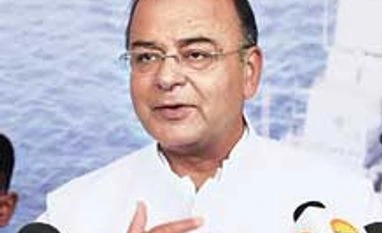
BS Reporter New Delhi Finance Minister Arun Jaitley on Thursday ruled out the possibility of a real estate bubble in the country which might engulf the entire economy, on the lines of a sub-prime crisis in certain countries like the US and Japan. Jaitley said the Budget proposals would boost the realty sector, which would help meet the housing needs of a vast section of the population.
Citing findings of the National Sample Survey Office (NSSO), his deputy, Nirmala Sitharaman, accused the United Progressive Alliance (UPA) government of jobless growth and said the Budget proposed incentives and rebates to the manufacturing sector, which will lead to economic expansion along with employment generation.
Replying to a debate on the Budget in the Rajya Sabha, Jaitley, however, remained silent on the Congress' demand that the incumbent regime should maintain the tradition of not reversing the policies of earlier governments by retaining 51 per cent foreign direct investment (FDI) cap in multi-brand retailing.
Jaitley said the economies, which witnessed the sub-prime crisis had a saturated realty sector, while housing needs of 60 per cent of the population are yet to be realised in India. The sub-prime crisis of the US had ultimately resulted in the global financial crisis of 2008-09.
The concern was particularly raised by former commerce and industry minister Anand Sharma, who quoted former Prime Minister Manmohan Singh in this respect.
"...It became a bubble to burst in those economies which were saturated with real estate and were moving from a saturation to a super-saturation. In a country where 60 per cent of the people, either living in slums or village huts, still have to have an access to housing, in a country where a dozen of townships have to come up, is there any option other than encouraging the real estate sector?" asked the finance minister.
Jaitley was referring to a pass-through status that the Budget had proposed for real estate investment trusts and an increase in income tax deduction limit from Rs 1.5 lakh to Rs lakh on housing loans a year.
To a query from the Opposition, he clarified that there was no change in the policy relating to the defence sector other than that FDI is being raised from 26 per cent to 49 per cent. The Opposition had asked for a clarification on whether role of the Cabinet will still be there in approving the FDI in defence and whether technology transfer will happen.
Accusing the UPA government of drying up investment by retrospective amendments of the Income Tax Act, Jaitley said the government had an option for the current litigation that arose due to the amendments. One was that the government could have passed a law in favour of companies or it could have allowed these litigations to reach their logical conclusions. "We opted for the second," he said.

 "Budget proposals to generate growth with employment: Jaitley")


 Connect with us on WhatsApp